


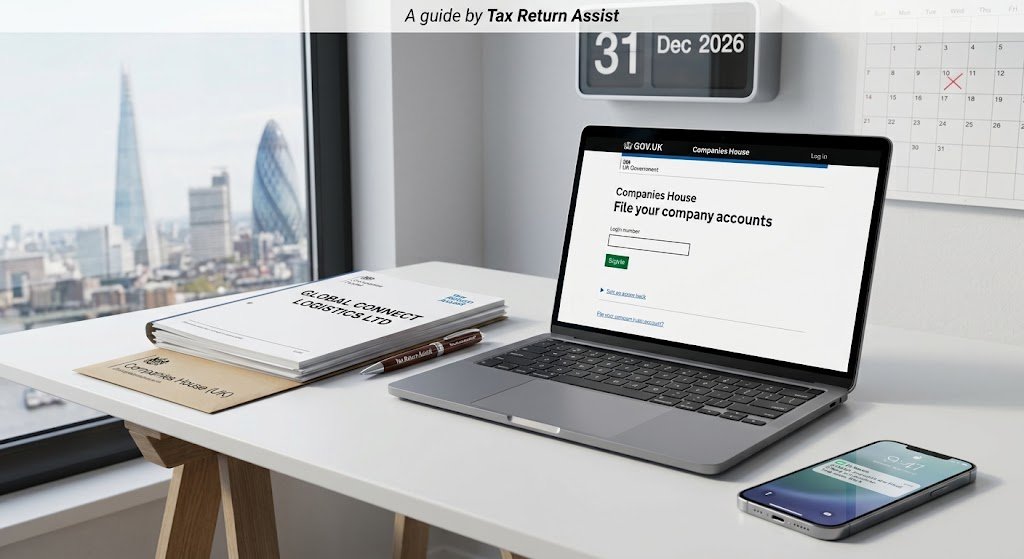
How to File Company Accounts with Companies House (2026 Guide)
September 28, 2026

September 28, 2026
You file company accounts by preparing statutory accounts that comply with UK accounting standards, then submitting them to Companies House online within 9 months of your financial year end. Most small and micro-entity companies file using Companies House WebFiling or commercial accounting software. Late filing triggers automatic penalties starting at £150 and rising to £1,500.
Filing company accounts is a separate obligation from filing your corporation tax return with HMRC. Both are required every year, with different deadlines and different submission routes. Missing either one carries its own penalties.
If you’d rather have an accountant handle the whole process, Tax Return Assist’s small business accountants prepare and file company accounts for limited companies across Essex and London. But if you want to understand the process first, here’s the full walkthrough.
Private limited companies: 9 months after the end of your financial year. If your financial year ends on 31 March 2026, your accounts must reach Companies House by 31 December 2026.
First-year companies: 21 months from the date of incorporation. If you incorporated on 1 June 2025, your first accounts are due by 1 March 2027. Your accounting reference date (the end of your financial year) is automatically set to the last day of the month you incorporated, so for a June incorporation, that’s 30 June. You can change this if you want a different year-end date.
You can check your exact deadline by searching your company on the Companies House website. Your next accounts filing date is displayed on the company overview page.
There’s no extension for being busy, for changing accountants, or for not realizing the deadline existed. Companies House grants extensions only in exceptional circumstances (natural disasters, serious illness), and you must apply before the deadline, not after.
Companies House penalties are fixed and automatic. No warnings, no grace period.
Up to 1 month late: £150.
1 to 3 months late: £375.
3 to 6 months late: £750.
Over 6 months late: £1,500.
If your company filed late in the previous year as well, the penalties are doubled. So a company that files more than 6 months late for the second consecutive year faces a £3,000 penalty.
These penalties are the company’s liability, not the director’s (unless the company can’t pay). But they’re completely avoidable and come out of company profits that could have gone to you as dividends.
Companies House penalties are separate from any HMRC penalties for late corporation tax returns. You can be hit with both at the same time.
The accounts you file depend on your company’s size. Most limited companies run by sole directors or small teams qualify as micro-entities or small companies.
Micro-entity accounts: Your company qualifies if it meets any 2 of these 3 conditions: turnover under £1 million, balance sheet total under £500,000, and fewer than 10 employees. Micro-entity accounts are the simplest format. You file a balance sheet and notes. Currently, you can omit the profit and loss account from the Companies House filing (though you still prepare one for your own records and for HMRC).
Small company accounts: Your company qualifies if it meets any 2 of these 3: turnover under £15 million, balance sheet total under £7.5 million, and fewer than 50 employees. Small companies file a balance sheet, notes and can currently omit the profit and loss account and directors’ report from the public filing.
Most one-person limited companies qualify as micro-entities. If you’re unsure, your accountant can confirm which category applies.
Balance sheet. A snapshot of what the company owns (assets) and owes (liabilities) on the last day of the financial year. Fixed assets, cash at bank, money owed by customers (debtors), money owed to suppliers (creditors), share capital and retained profits.
Profit and loss account (P&L): A summary of the company’s income and expenses during the financial year, showing whether the company made a profit or a loss. Currently, micro-entities and small companies can omit this from the Companies House filing, but it must still be prepared for HMRC and for the company’s own records.
Notes to the accounts: Additional information required by accounting standards: accounting policies used, details of directors’ loans, related-party transactions, and any other disclosures required by the applicable reporting framework (FRS 105 for micro-entities, FRS 102 Section 1A for small companies).
Directors’ report: Small companies are currently exempt from filing a directors’ report with Companies House, though they may choose to prepare one for internal use.
All accounts must be approved by a director and include the director’s name on the balance sheet. The accounts must comply with UK Generally Accepted Accounting Practice (UK GAAP).
Step 1. Prepare your accounts: This is the hard part. Your accounts must comply with UK accounting standards and accurately reflect the company’s financial position. For micro-entities, the format is simpler, but the numbers still need to be correct. Most directors use an accountant for this step.
Step 2. Get director approval: At least one director must approve the accounts and authorize them for filing. The director’s name appears on the balance sheet. In a single-director company, that’s you.
Step 3. File with Companies House: You have several options:
Companies House WebFiling: Free to use. Suitable for micro-entity and dormant company accounts. You log into your Companies House account, select “File accounts,” and enter the figures from your prepared accounts into the online form. The system generates the filing in the correct format.
Commercial software: Accounting packages like Xero, FreeAgent, Sage, and others can generate accounts in iXBRL format and file directly with Companies House. If your accountant prepares your accounts using professional software, they can file from within the package.
The old HMRC joint filing service (which allowed you to file company accounts and the corporation tax return together) closed on 31 March 2026. Accounts and corporation tax returns must now be filed separately.
Step 4. Receive confirmation: Companies House sends an email confirming receipt. Your company’s filing history on the Companies House website updates to show the accounts have been filed. Keep the confirmation for your records.
Filing accounts with Companies House doesn’t file your corporation tax return. These are two separate obligations with different deadlines.
Corporation tax return (CT600): filed with HMRC. The deadline is 12 months after the end of your accounting period. If your year ends 31 March 2026, the CT600 is due by 31 March 2027.
Corporation tax payment: due 9 months and 1 day after your accounting period ends. For a 31 March 2026 year end, that’s 1 January 2027. Payment is due before the return.
Your corporation tax return is based on the same figures as your company accounts, but it includes additional calculations for tax purposes (capital allowances, disallowable expenses, and tax reliefs). Most accountants prepare the accounts and the CT600 at the same time.
Every company must also file a confirmation statement with Companies House at least once every 12 months. This confirms that the company’s registered details (registered office, directors, shareholders, and people with significant control) are up to date.
The fee is £13 if filed online. The deadline is 14 days after the anniversary of your incorporation date (or the date you last filed a confirmation statement). Late filing can lead to the company being struck off the register.
This is a separate filing from your annual accounts. It takes about 10 minutes if nothing has changed.
Companies House has confirmed significant changes to filing requirements for financial years beginning on or after 1 April 2028:
Profit and loss accounts must be filed: Small companies and micro-entities will be required to file a P&L with Companies House. Currently, they can omit it. The P&L won’t be published on the public register if the company opts out, but it must be filed.
All accounts must be filed using commercial software: The existing Companies House WebFiling and paper filing routes for accounts will close. All filings will need to be in iXBRL format and submitted through approved software.
Abridged accounts option removed: Companies will no longer be able to file abridged accounts. They’ll file full accounts with the option to restrict certain information from the public register.
These changes don’t affect filings made before April 2028. But if you’re currently filing micro-entity accounts through WebFiling, you’ll need to transition to commercial software by then. Starting to use accounting software now makes the transition easier.
Technically yes. Directors are legally responsible for the company’s accounts regardless of whether they prepare them personally or use an accountant.
In practice, filing your own accounts is realistic if your company is dormant (no transactions) or a very simple micro-entity with a handful of transactions. The Companies House WebFiling tool walks you through the format.
For trading companies with any complexity (multiple expense categories, director loans, dividends paid, asset purchases, capital allowances), an accountant significantly reduces the risk of errors. Incorrect accounts can trigger HMRC enquiries, Companies House rejections, and personal liability issues.
The accounts preparation fee for a small limited company is typically £500 to £1,500 per year. That covers both Companies House accounts and the CT600 for HMRC. For most directors, this represents a fraction of the tax saved by having expenses and allowances correctly applied. See our guide to limited company accountant fees for a full pricing breakdown.
Tax Return Assist prepares and files company accounts for limited companies across Essex and London. Their accountants handle the full process: year-end accounts, corporation tax return, Companies House filing and confirmation statement. You get clean accounts, filed on time, with every legitimate allowance claimed.
Call 02039377911, email contact@taxreturnassist.co.uk or use the online quote form.
Disclaimer: This article is for general information purposes only and does not constitute professional financial, tax or legal advice. Tax rules and rates can change, and individual circumstances can affect the amount of tax payable. Always check the latest HMRC guidance or speak to a qualified accountant or tax adviser before making tax decisions. Tax Return Assist accepts no liability for actions taken based on the information contained in this article.

Expert tax & accountancy services for individuals, businesses, and contractors across the UK — fixed monthly or one-time fees. Trusted for our all-inclusive service plans.
Tax Return Assist Ltd is a registered Companies House Authorised ACSP, professionally regulated under the Institute of Financial Accountants (IFA).
Leave a comment