


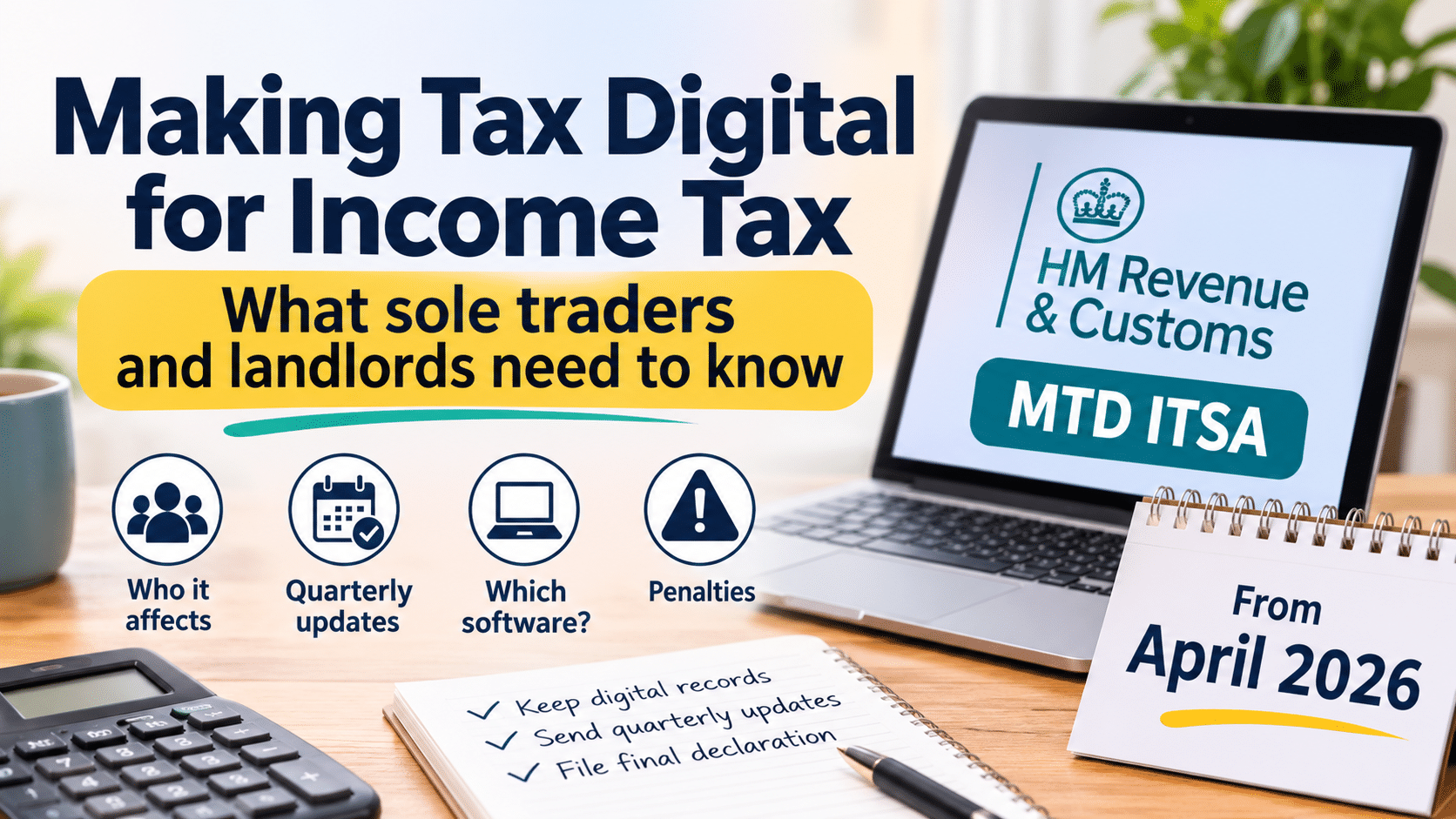
What is Making Tax Digital for income tax and does it affect you?
November 3, 2026

November 3, 2026
Making Tax Digital for Income Tax (MTD ITSA) is the biggest change to personal tax reporting in a generation. Instead of filing one annual Self Assessment return, affected sole traders and landlords now need to keep digital records and send quarterly income summaries to HMRC through compatible software.
The first phase went live on 6 April 2026 for anyone with qualifying income above £50,000. A second phase kicks in from April 2027 at a £30,000 threshold, and a third from April 2028 at £20,000. If you’re self employed or you earn rental income, this will affect you sooner or later. You can read HMRC’s official Making Tax Digital guidance for further details.
MTD ITSA applies to sole traders and landlords whose combined gross annual income from self employment and UK property exceeds the relevant threshold. From 6 April 2026, that threshold is £50,000. From 6 April 2027 it drops to £30,000, and from 6 April 2028 it drops again to £20,000.
The key word here is gross income. You don’t deduct expenses before checking whether you cross the threshold. A sole trader earning £55,000 in total sales is in scope even if their profit after expenses is £25,000. And if you have both self employment income and rental income, those figures are combined. So £30,000 from a trade plus £25,000 from a rental property puts you at £55,000 and into the first phase.
HMRC uses your 2024/25 Self Assessment return to identify whether you cross the £50,000 threshold. If you do, they’ll notify you that you must join MTD from 6 April 2026.
Limited companies are completely outside the scope of MTD ITSA. Corporation tax reporting is separate, and HMRC hasn’t set a date for MTD for Corporation Tax. If you’re a limited company director and your only income comes through salary and dividends from your company, MTD ITSA doesn’t apply to you.
Partnerships are also excluded from the current rollout, though HMRC plans to bring them in at a later date. Trusts, estates, personal representatives of deceased persons and non resident companies are all outside scope too. Employment income (PAYE), dividends, pension income, savings interest and capital gains don’t count towards the qualifying income threshold.
There’s also a digital exclusion exemption. If you genuinely can’t use digital tools due to age, disability, location or religious beliefs, you can apply to HMRC for an exemption. But HMRC scrutinises these applications closely, and not wanting to pay for software isn’t a valid reason.
Under MTD ITSA, you send 4 quarterly updates per year to HMRC. Each update summarises your business income and expenses for that quarter. The standard quarterly periods and their deadlines are:
After the final quarterly update, you also need to submit an End of Period Statement (EOPS) and a Final Declaration. The Final Declaration replaces the traditional Self Assessment tax return and is due by 31 January following the end of the tax year, just like the old system. Tax payments are still due by 31 January too, so that deadline hasn’t changed.
Quarterly updates aren’t as intimidating as they sound. Each submission contains summary totals of your income and expenses for that period, broken down by category. You’re not sending individual receipts or transaction records to HMRC. It’s a high level summary submitted through your software.
Your software pulls the figures from the digital records you’ve been keeping throughout the quarter. If your bookkeeping is up to date, the quarterly update itself takes minutes. The real work is in maintaining accurate digital records as you go, rather than piling everything up for year end.
HMRC won’t receive copies of individual transactions or see your personal expenditure. They get category totals only. The detail stays in your records, which you must keep for at least 5 years in case of an enquiry.
You must use HMRC compatible software that can maintain digital records, submit quarterly updates through a digital link and file your Final Declaration. Software you used for previous Self Assessment returns may not support MTD, so check before assuming you’re covered.
HMRC maintains an approved list of MTD ITSA software providers on GOV.UK. Options range from free tools to full accounting packages like Xero, QuickBooks and FreeAgent. Some software handles both quarterly updates and the year end return. Others only do one, so check what’s included before you sign up.
If you already use software for MTD for VAT, you may be able to extend it to cover income tax as well. But the two systems have separate requirements, so confirm with your provider. If you’re not sure which software suits your business, our bookkeeping team can help you get set up.
HMRC has confirmed a soft landing for the first mandatory year. For the 2026/27 tax year (April 2026 to April 2027), there are no penalty points for missing quarterly update deadlines. This gives you time to adjust to the new system without facing fines for late submissions.
But this soft landing only covers quarterly updates. It does not apply to the Final Declaration (due 31 January 2028) or to late tax payments. If you miss the Final Declaration deadline or pay your tax late, the normal penalties still apply. From the 2027/28 tax year onwards, quarterly update penalties kick in under the new points based system.
MTD ITSA uses a points based penalty system for late submissions. Every time you miss a quarterly update deadline, you receive 1 penalty point. Once you hit 4 points (the threshold for quarterly submissions), you receive a £200 penalty. Every further missed deadline after that triggers another £200.
Points can be reset to zero if you meet all your submission deadlines for a set period and bring all outstanding returns up to date. This is designed to encourage ongoing compliance rather than punishing the occasional slip.
Late payment penalties are separate. If you pay tax late, HMRC charges a first penalty at 15 days overdue and a second at 30 days. Interest also accrues from the date the payment was due. These penalties apply regardless of whether you’re in the soft landing period for quarterly updates.
MTD for VAT has been mandatory for all VAT registered businesses since April 2019. If you’re already complying with MTD for VAT, the concept of digital records and software filing will be familiar. But MTD for Income Tax is a separate obligation with its own requirements.
The main differences: MTD for VAT covers your business’s VAT returns. MTD ITSA covers your personal income tax from self employment and property. You submit VAT returns quarterly (or annually depending on your scheme), while MTD ITSA requires quarterly income and expense updates plus an end of year Final Declaration. If you’re both VAT registered and above the income threshold, you’ll need to comply with both systems. The two don’t replace each other.
For a full breakdown of VAT obligations, see our guide on VAT returns and how to file them.
If you’re a sole trader or landlord with gross income above £50,000, MTD ITSA is already live for you. The first quarterly update for 2026/27 was due by 7 August 2026. If you haven’t signed up yet, do it now through your HMRC online account or ask your accountant to handle it.
If your income is between £30,000 and £50,000, you have until April 2027. But starting early gives you time to choose software, set up digital records and get comfortable with quarterly reporting before it becomes mandatory. Waiting until the last minute is how people end up scrambling.
The most practical step is to move your bookkeeping to compatible software now. If you’re still using spreadsheets or paper records, the transition takes longer than you think. And if you’re already working with an accountant, confirm that they’re set up for MTD ITSA and can submit quarterly updates on your behalf. At Tax Return Assist, we handle the full MTD process for our self employed clients and landlords.
Yes. Your accountant can submit quarterly updates, the End of Period Statement and the Final Declaration on your behalf using agent software. You still need to keep your own digital records up to date, but the actual submissions and compliance can be managed by your accountant.
At Tax Return Assist, we work with sole traders, freelancers and landlords across the UK to manage MTD ITSA from start to finish. We’ll help you choose the right software, set up your digital records, submit your quarterly updates on time and file your Final Declaration. Our monthly accountancy packages start from £50 per month and cover everything from bookkeeping to tax returns.
Disclaimer
This article is for general information only. Tax rules change and individual circumstances vary. Always check the latest HMRC guidance or speak to a qualified accountant before making decisions based on this content.
Get ready for Making Tax Digital
Tax Return Assist helps sole traders and landlords stay compliant with MTD for Income Tax. From software setup to quarterly submissions, we handle the process so you can focus on your business.
Call us on 02039377911 or email contact@taxreturnassist.co.uk.
Get an instant quote and take the stress out of MTD.

Expert tax & accountancy services for individuals, businesses, and contractors across the UK — fixed monthly or one-time fees. Trusted for our all-inclusive service plans.
Tax Return Assist Ltd is a registered Companies House Authorised ACSP, professionally regulated under the Institute of Financial Accountants (IFA).
Leave a comment