The online self assessment deadline for the 2025/26 tax year is 31 January 2027. That’s the date for both filing your return and paying any tax you owe. Miss it and HMRC charges a £100 penalty automatically, even if your tax bill is zero.But 31 January isn’t the only date that matters. There are 4 deadlines across the year, and the penalties for missing them stack up faster than most people realise.If you’d rather not track any of these dates yourself,Tax Return Assist’s personal tax accountants handle the whole process, from filing to payment reminders, so you never need to worry about a deadline again.
What are the four key dates you need to know?
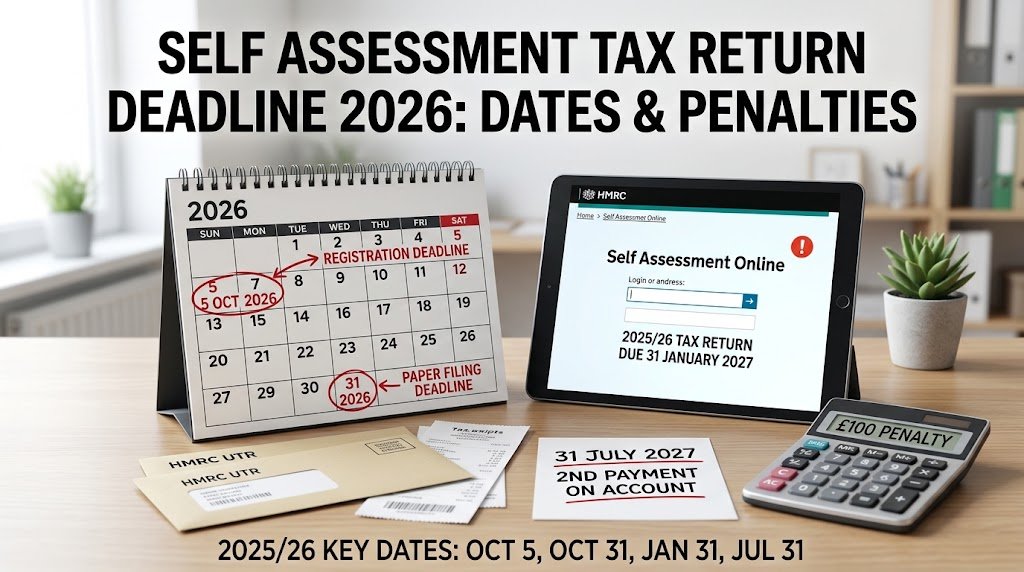
The 2025/26 tax year covers income earned from 6 April 2025 to 5 April 2026. Here are the deadlines that follow:
5 October 2026 registration deadline:
If this is your first time filing, you must register with HMRC for self assessment by this date. That allows HMRC time to send your Unique Taxpayer Reference (UTR) by post before the filing deadlines arrive. Leave it later than this date, and you will already be behind.
31 October 2026 paper filing deadline:
If you’re filing a paper return (form SA100), it has to reach HMRC by this date. Paper filers have a shorter window because HMRC needs time to calculate your tax manually. Most people file online now, but if you’re using paper, the 31st of January is the deadline.
31 January 2027 online filing and payment deadline:
This date is the big one. Your online return must be submitted, and any tax owed must be paid by midnight. Both. Same day. HMRC collected £325 million in penalties and interest from late payers in the last year alone. Don’t add to that number.
31 July 2027 second payment on account is due:
If HMRC has asked you to make payments on account (advance payments towards next year’s bill), the second installment is due on this date. The first one was due back on 31 January alongside your main payment.
Can you file early without making an early payment?
Yes. This confuses many people, but the dates are separate.You can submit your 2025/26 return as early as 6 April 2026 (the day after the tax year ends). But your payment isn’t due until 31 January 2027. Filing early just means you know your bill sooner. You can budget for it, set money aside, or even set up a budget payment plan with HMRC to spread the cost monthly.There’s no advantage to waiting. File in May and you’ve got 8 months to prepare for the bill. File it on 30 January, and you’ve got 24 hours. The math isn’t complicated.
What happens if you file your return late?
HMRC’s penalty structure for late filing is fixed. It doesn’t matter how much tax you owe. It doesn’t matter if you owe anything. The penalties kick in based purely on how late the return is.1 day late: £100 penalty. Automatic. No warning. No grace period. File your return on 1 February 2027 instead of 31 January, and you owe HMRC £100 before you’ve even looked at your tax bill.3 months late (after 1 May 2027): £10 per day. On top of the £100, HMRC starts charging £10 for every day your return is outstanding. This runs for up to 90 days, adding a maximum of £900. So at this point you’re looking at £1,000 in penalties and you still haven’t filed.6 months late (after 1 August 2027): £300 or 5% of your tax bill. Whichever is higher. This stage is where the penalties start scaling with your income. If you owe £10,000 in tax, that’s a £500 penalty at this stage. If you owe less than £6,000, it’s £300.12 months late (after 1 February 2028): another £300 or 5% of your tax bill. Same calculation again. In serious cases where HMRC believes you’re deliberately withholding information, they can charge up to 100% of the tax due.Add those up for a worst-case scenario. If you owe £5,000 in tax and file 12 months late, you’re facing a £100 initial penalty, plus £900 in daily penalties, plus £300 at 6 months, plus £300 at 12 months. That’s £1,600 in filing penalties alone, before any payment penalties or interest.
What happens if you pay your tax late?
Late payment penalties are separate from late filing penalties. You can be hit with both at the same time if you file late and pay late.30 days late: 5% surcharge: If your tax is still unpaid 30 days after the 31 January deadline, HMRC charges 5% of the outstanding amount. Owe £4,000 and haven’t paid by 2 March 2027? That’s a £200 surcharge.6 months late: another 5%: A second 5% charge on whatever’s still unpaid at the 6-month mark. This is calculated on the remaining balance, not the original bill, so paying down part of the debt reduces this charge.12 months late: another 5%. A third 5% charge. If you’ve paid nothing for a full year, these three surcharges together amount to 15% of your original tax bill.On a £10,000 tax bill left completely unpaid for 12 months, that’s £1,500 in surcharges. On top of the filing penalties. On top of that, there’s also interest.
How does HMRC calculate interest on unpaid tax?
Interest is charged separately from penalties. It runs from the day after the payment deadline (1 February 2027 for the 2025/26 tax year) until the day HMRC receives your payment. Every single day.The rate is the Bank of England base rate plus 4 percentage points. As of early 2026, that puts it at 7.75% per year. The rate moves whenever the Bank of England adjusts its base rate, so check GOV.UK for the current figure.On a £5,000 tax bill, 7.75% interest works out to roughly £1.06 per day. That’s about £96 after 3 months and £387 after a year. It doesn’t sound dramatic in isolation, but stacked on top of the penalties, the total climbs fast.Interest is statutory. It can’t be appealed or waived, even if you successfully appeal a penalty. The only exception is where HMRC’s own error caused the delay.
What is the actual cost of a late return? A worked example
Say you owe £5,000 in tax for 2025/26. You file your return and pay the bill 7 months late (September 2027).Late filing penalties: £100 (day 1) + £900 (daily penalties for 90 days) + £300 (6-month penalty) = £1,300.Late payment penalties: £250 (5% at 30 days) + £250 (5% at 6 months) = £500.Interest: roughly £225 (7 months at 7.75% on £5,000).Total cost of being late: approximately £2,025 on top of the £5,000 you already owed. That’s a 40% premium for doing nothing differently except being 7 months slow.
Can you appeal a self assessment penalty?
You can, but only if you have a “reasonable excuse.” HMRC’s bar for justification is high.Excuses they accept: serious illness or hospitalisation that prevented you from filing, bereavement of a close relative, unexpected HMRC website or system failure, postal delays where you filed by post in good time, and fire, flood, or theft that destroyed your records.Excuses they don’t accept: not knowing you needed to file, finding the form confusing, relying on an accountant who missed the deadline (you’re still personally responsible), being too busy or not having the money to pay (the latter isn’t a valid reason for late filing, only for late payment).You’ve got 30 days from the date on the penalty notice to appeal. Do it through your Government Gateway account or by submitting form SA370. If HMRC rejects your appeal, you can escalate to the First-Tier Tax Tribunal.
What if you can’t afford to pay by the deadline?
File your return on time anyway: Filing late and paying late will double the penalties. If you file on time but can’t pay, you avoid the entire late filing penalty structure (£100 + £900 + two lots of £300). That alone could save you £1,600.Then contact HMRC about a Time to Pay (TTP) arrangement. You can set one up online for debts up to £30,000 without speaking to anyone. HMRC splits your bill into monthly installments, typically over 12 months.If you arrange TTP before the 30-day mark, you can avoid the 5% late payment surcharges entirely. Interest still runs on the balance, but that’s unavoidable. The surcharges are the expensive part, and they’re preventable.If the process feels overwhelming,Tax Return Assist’s small business accountants can help you file on time and set up a payment plan. Getting the return in before the deadline is the single most valuable thing you can do to limit the damage.
What are payments on account, and when are they due?
If your self assessment tax bill is over £1,000 and less than 80% was deducted at source (through PAYE), HMRC requires payments on account. These are advance payments towards next year’s bill, each equal to half of your current year’s liability.First payment on account: 31 January 2027 (same day as the main payment deadline).Second payment on account: 31 July 2027.So if your 2025/26 tax bill is £6,000, you’d pay the £6,000 plus two payments on account of £3,000 each. That’s £9,000 going out on 31 January 2027, with another £3,000 due in July. First-time filers get hit hardest because they weren’t expecting the advance payments.If you know your income will be lower next year, you can apply to reduce your payments on account through your HMRC online account. But be careful. If you reduce them too much and your actual bill turns out higher, HMRC charges interest on the shortfall.
Do Making Tax Digital deadlines change anything for 2025/26?
Not for this specific tax year. The 2025/26 return is still filed under the traditional self assessment system with the deadlines listed above.From 2026/27 onward, sole traders and landlords with qualifying income from self-employment and property above £50,000 will need to submit quarterly updates under Making Tax Digital for Income Tax. PAYE income does not count toward this threshold.If you’re not certain how MTD affects your situation,the self-employed accountant team at Tax Return Assist can walk you through the transition and handle the quarterly submissions on your behalf.
Don’t let the deadlines catch you out
The dates are fixed. 5 October 2026 to register. 31 October 2026 for paper returns. 31 January 2027 for online filing and payment. 31 July 2027 for the second payment on account.Please add them to your calendar now. Set reminders for a month before each one. The cost of being late is real, measurable, and entirely avoidable.To get your 2025/26 return filed well before the deadline, call Tax Return Assist on 02039377911, email contact@taxreturnassist.co.uk, orget an instant quote online. Their accountants acrossEssex andLondon file hundreds of returns every year, always on time.
Disclaimer
Disclaimer: This article is for general information purposes only and does not constitute professional financial, tax, or legal advice. Tax rules change frequently, and individual circumstances vary. Always consult a qualified accountant or tax adviser before making decisions based on this content. Tax Return Assist accepts no liability for actions taken based on the information provided here.




Leave a comment