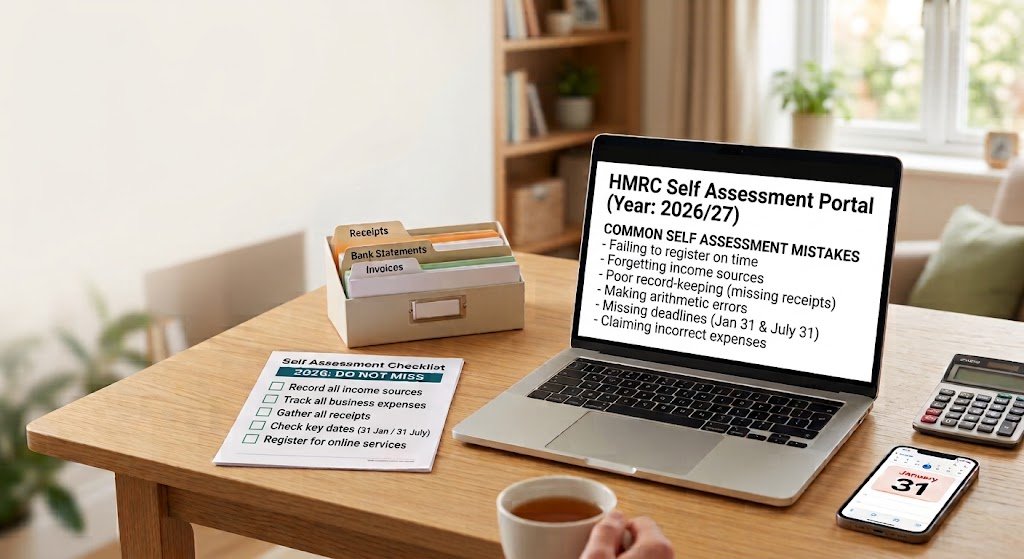
The most common self assessment mistakes are missing the filing deadline, not claiming all allowable expenses, using the wrong tax year’s figures, forgetting to declare all income sources, and ignoring payments on account. Each one either costs you money in penalties or means you’re paying more tax than you need to.HMRC processes around 12 million self assessment returns every year. A significant chunk of them contain errors. Some trigger investigations. Some result in overpaid tax that never gets reclaimed. Most are completely avoidable.Below are the mistakes we see most often at Tax Return Assist, along with how to avoid each one.
1. Filing your return late
This is the single most expensive mistake and the easiest to avoid. Around 600,000 people missed the January 2025 deadline. Every one of them received an automatic £100 penalty.The penalty applies whether you owe £50,000 or nothing at all. It’s a filing penalty, not a payment penalty. After 3 months, HMRC adds £10 per day (up to £900). After 6 months, it’s £300 or 5% of your tax bill. After 12 months, the same again.How to avoid it: File early. You can submit your 2025/26 return from 6 April 2026 onward. Filing in May or June gives you months of breathing room. There’s no advantage to waiting and no penalty for filing early. Your payment isn’t due until 31 January regardless of when you file.
2. Not claiming all your allowable expenses
This is the mistake that costs people the most tax. Sole traders and freelancers routinely leave money on the table because they don’t realize what they can claim or they’ve lost the receipts.Common expenses people forget: a proportion of home utility bills if you work from home; business mileage (45p per mile for the first 10,000 miles); professional subscriptions and memberships; accounting fees; phone costs (business percentage); software and app subscriptions; training courses directly related to your current work; and stationery and postage.On the other end, some people claim things they shouldn’t (commuting costs, clothing that isn’t a uniform, client entertainment) and invite HMRC inquiries. The rule is simple: the expense must be wholly and exclusively for business purposes. If it’s partly personal, claim the business proportion only.How to avoid it: Track expenses throughout the year, not in January. Use accounting software or a simple spreadsheet. If you’re not sure what’s claimable, a small business accountant can review your expenses and make sure you’re claiming everything legitimate without crossing lines.
3. Using the wrong tax year
The UK tax year runs from 6 April to 5 April. Not January to December. Not your company’s financial year. HMRC’s tax year.Your 2025/26 return covers income earned between 6 April 2025 and 5 April 2026. If you accidentally include income from March 2025 (which belongs in the 2024/25 return) or exclude income from April 2025 (which belongs in 2025/26), your figures will be wrong.This happens most often with bank interest statements (which often run a calendar year) and with invoices raised near the April boundary. If you invoiced a client on 3 April 2025 but got paid on 10 April, the treatment depends on whether you use cash-basis or accrual-basis accounting.How to avoid it: Filter every income and expense record by the 6 April to 5 April dates before you start entering anything. If you use accounting software, set the reporting period to the tax year, not the calendar year.
4. Forgetting to declare all income
HMRC already knows about most of your income. Your employer reports your salary through RTI. Banks report your interest. Investment platforms report your dividends. HMRC cross-references all of this against your return.If you leave out your bank interest because you forgot, or you omit a small freelance job because it was only £500, HMRC’s systems will eventually flag the mismatch. That can trigger a compliance check, which is stressful, time-consuming, and potentially expensive if they find you underpaid.Common income sources people forget: savings interest from multiple banks (each below the allowance, but combined they exceed it); dividend income from old share holdings; ad hoc freelance work paid in cash; rental income from a spare room above the £7,500 Rent a Room threshold; and crypto gains above the £3,000 annual exempt amount.How to avoid it: Before you start your return, pull together every income source. Check all your bank accounts for interest payments. Check any investment platforms. Review your invoices. If you earned it between 6 April 2025 and 5 April 2026, it goes on the return.
5. Getting your personal details wrong
It sounds trivial, but entering the wrong National Insurance number, misspelling your name, or using an old address can cause your return to be rejected or delayed. HMRC matches your details against their records, and any discrepancy creates a problem.This is especially common for people who’ve recently married and changed their name, moved house, or have multiple National Insurance numbers from previous administrative errors.How to avoid it: Check your personal details in your HMRC online account before you start the return. If anything has changed, update it first.
6. Ignoring payments on account
This catches first-time filers hardest. If your tax bill is over £1,000 and less than 80% was collected at source through PAYE, HMRC requires advance payments towards next year’s bill. Each payment on account is half of your current year’s liability.So if your 2025/26 bill is £4,000, you pay the £4,000 plus two payments on account of £2,000 each. That means £6,000 going out on 31 January 2027, with another £2,000 due on 31 July 2027. People budget for the tax bill but not the advance payments, then panic when the number is 50% higher than expected.How to avoid it: If you know your income will be significantly lower next year, you can apply to reduce payments on account through your HMRC online account. Otherwise, budget for 150% of your expected tax bill if it’s your first year filing.
7. Not keeping proper records
HMRC requires you to keep records for at least 5 years after the 31 January submission deadline. If they open an inquiry and you can’t produce evidence for an expense you claimed, they’ll disallow it and charge you the extra tax plus interest.A shoebox of crumpled receipts doesn’t count as proper records. Neither does “I think it was about £200.” HMRC wants actual receipts, invoices, bank statements, and mileage logs. Digital copies are fine.How to avoid it: Photograph receipts when you get them (paper fades). Use cloud storage or accounting software. Record business mileage as you drive, not 9 months later from memory. If you hate admin, a bookkeeping service can handle the organization for a fixed monthly fee.
8. Mixing up cash basis and accrual basis
Most sole traders with turnover under £150,000 can use the simpler cash basis, where you record income when you receive it and expenses when you pay them. The accruals basis records income when you invoice it and expenses when you’re billed, regardless of when money actually moves.Problems arise when you use one method for part of your return and the other for the rest or when you switch between them without adjusting properly. This creates gaps or double-counting that HMRC’s checks will eventually catch.How to avoid it: Pick one method and stick with it consistently. Cash basis is simpler and suits most small businesses. If you’re not sure which applies to you, ask your accountant before you start the return, not halfway through.
9. Claiming the wrong mileage rate
The approved mileage rate for cars is 45p per mile for the first 10,000 business miles in a tax year, then 25p per mile after that. Motorcycles are 24p. Bicycles are 20p.Two common errors are claiming 45p for all miles regardless of the 10,000 threshold and claiming mileage on top of actual car running costs. You get one or the other. If you claim the flat rate per mile, you can’t also claim fuel, insurance, and servicing. If you claim actual costs, you can’t also claim the per-mile rate.Another frequent mistake: claiming commuting miles. Travel from home to a regular workplace isn’t a business journey. Travel from home to a temporary client site is. The distinction matters.How to avoid it: Keep a mileage log with the date, destination, purpose, and miles for every business journey. Record it at the time, not from memory months later.
10. Not claiming the marriage allowance or other reliefs
The marriage allowance lets a non-taxpayer (or basic rate taxpayer earning under £12,570) transfer £1,260 of their personal allowance to their spouse or civil partner. It’s worth up to £252 per year in tax savings. And you can backdate it up to 4 years.Other commonly missed reliefs: the £1,000 trading allowance (which means you don’t need to report small side income at all), the £1,000 property allowance, tax relief on pension contributions for higher rate taxpayers (the basic rate relief is given automatically, but you need to claim the rest through self assessment) and Gift Aid donations (which extend your basic rate band).How to avoid it: Check HMRC’s list of reliefs before you file. Better yet, have an accountant review your return. The cost of a basic review is usually far less than the tax savings they find.
11. Filing but forgetting to pay
Submitting your return is only half the job. If you file on 31 January but forget to actually pay the bill on the same day, the late payment penalties start building. A 5% surcharge hits at 30 days, another at 6 months, and another at 12 months. Interest runs from day one.People sometimes assume the payment will be taken automatically. It won’t (unless you’ve set up a direct debit, which takes 5 working days to process the first time). You need to actively send the money.How to avoid it: Pay on the same day you file. Use online banking with HMRC’s payment reference (your UTR followed by K). It clears within 24 hours. Don’t leave payment to the last day if you’re using direct debit for the first time.
Let an expert file it and avoid the mistakes entirely
Every mistake on this list is avoidable. But some of them are subtle enough that even careful people get caught out, especially in their first year of filing.Tax Return Assist handles self assessment returns for sole traders, landlords, contractors, and small businesses across Essex and London. Their accountants check every figure, claim every legitimate expense, and file on time. Every time.Call 02039377911, email contact@taxreturnassist.co.uk or use the online quote form to get your 2025/26 return done right.
Disclaimer
Disclaimer: This article is for general information purposes only and does not constitute professional financial, tax or legal advice. Tax rules change frequently and individual circumstances vary. Always consult a qualified accountant or tax adviser before making decisions based on this content. Tax Return Assist accepts no liability for actions taken based on the information provided here.




Leave a comment