


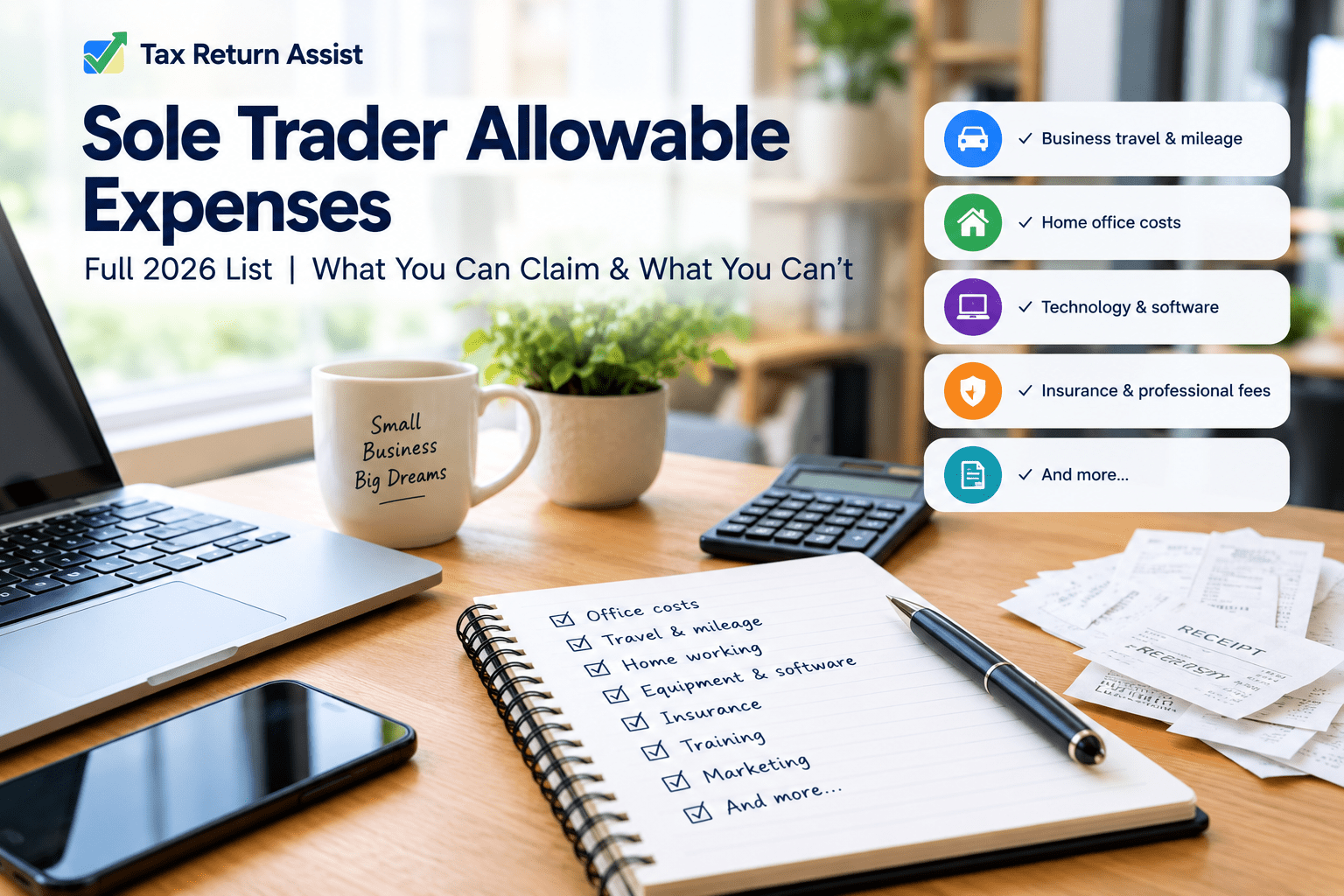
Allowable Business Expenses for Sole Traders (Full 2026 List)
September 10, 2026

September 10, 2026
A sole trader can claim any expense that was incurred wholly and exclusively for business purposes. That’s HMRC’s test. If you wouldn’t have paid for it without the business, it’s probably allowable. If you’d have paid for it anyway (rent on your home, food you’d eat regardless, clothes you wear outside work), it’s not.
Every pound you claim reduces your taxable profit. A basic rate taxpayer saves 26p per pound of expenses (20% income tax + 6% Class 4 NIC). A higher rate taxpayer saves 42p. Failing to claim legitimate expenses is one of the most common and most expensive mistakes sole traders make.
Below is the full list for 2025/26. If you’re not sure whether a specific expense qualifies, Tax Return Assist’s self-employed accountants can review your records and make sure you’re claiming everything you’re entitled to without crossing any lines.
Working from home. If you use part of your home for business, you can claim a proportion of your household running costs. HMRC offers two methods:
Simplified expenses (flat rate): £10 per month if you work from home 25 to 50 hours. £18 per month for 51 to 100 hours. £26 per month for 101 hours or more. No receipts needed for household bills. Just track your hours.
Actual costs: calculate the business proportion of your heating, electricity, council tax, mortgage interest (or rent), water, broadband and home insurance. The formula HMRC accepts is (rooms used for business ÷ total rooms) × (business hours ÷ total hours) × annual costs. This method often gives a larger deduction if you have a dedicated room and significant bills, but it requires evidence.
You can’t mix methods within the same category. Pick flat rate or actual costs for home expenses and stick with it for the tax year.
Office supplies. Stationery, printer ink, paper, envelopes, postage stamps, packing materials. All fully claimable.
Office furniture and equipment. Desks, chairs, shelving, filing cabinets. Items costing under £1,000 can typically be claimed in full as revenue expenses. Larger purchases may qualify for capital allowances under the Annual Investment Allowance (£1 million limit).
Business mileage (simplified flat rate). 45p per mile for the first 10,000 business miles in the tax year. 25p per mile after that. Motorcycles: 24p per mile. Bicycles: 20p per mile. These rates cover all running costs (fuel, insurance, repairs, MOT, road tax, depreciation), so you can’t claim actual vehicle costs on top.
Actual vehicle costs (alternative method). Claim the business proportion of all real vehicle expenses: fuel, insurance, repairs, servicing, road tax, breakdown cover, lease payments, parking and the capital allowance on the purchase price. This requires a mileage log to calculate the business percentage. For most sole traders doing under 10,000 business miles in a normal car, the flat rate is simpler and often larger.
Public transport. Train, bus, tube, taxi and coach fares for business journeys. Fully claimable.
Parking and tolls. Business parking, congestion charges and road tolls. Not parking fines.
Accommodation and subsistence. Hotel, B&B and reasonable meal costs when you’re away from your normal place of business overnight. Day-trip meals are more restricted. HMRC generally allows meals only when you’re travelling to a temporary workplace away from your usual base.
What doesn’t count: commuting between your home and your regular place of work is never a business journey. If you work from home and travel to a client’s site, that’s business travel. If you rent an office and drive there every day, that’s commuting.
Computers, laptops and tablets. Fully claimable if used exclusively for business. If you also use the device personally, claim the business proportion only. A laptop used 70% for work and 30% personally: claim 70% of the cost.
Software and subscriptions. Accounting software (Xero, FreeAgent, QuickBooks), design tools (Adobe Creative Cloud), project management tools, cloud storage, website hosting, domain names, email services. All claimable if used for business.
Phone costs. If you have a dedicated business phone, the full cost is claimable. If you use a personal phone for business, claim the business proportion of your contract or bill. Keep a record of how you’ve calculated the split.
Broadband and internet. Business proportion of your home broadband if you work from home. Note: if you’re using the simplified flat rate for home expenses, that covers heating and lighting but not broadband or phone costs. You can claim broadband separately on top of the flat rate.
Accountancy and tax advice. Fees paid to your accountant for preparing accounts, filing your tax return and providing tax advice. Fully claimable.
Legal fees. Solicitor fees related to your business: contract reviews, debt collection, employment disputes, property lease negotiations. Not legal fees for personal matters or for buying capital assets (those are added to the asset’s cost for capital allowances).
Professional memberships and subscriptions. Annual fees for trade bodies, professional institutions and regulatory bodies relevant to your work. HMRC maintains a list of approved professional bodies whose subscriptions qualify for tax relief.
Insurance. Professional indemnity insurance, public liability insurance, business contents insurance, business interruption insurance. All claimable. Personal insurance (life insurance, health insurance) is not.
Website design and development, SEO services, social media advertising, Google Ads, printed flyers and business cards, trade show stands and exhibition costs, branded merchandise, directory listings and PR services. All claimable if they promote your business.
Client entertaining is not claimable. Taking a client to lunch, buying them gifts, hospitality at events. HMRC specifically disallows client entertainment. You can still do it, but you can’t deduct it from your taxable profit. Staff entertainment (like a Christmas party) has different rules and is generally allowable within limits.
This is one of the most misunderstood categories. The rule is strict.
Claimable: uniforms with your business logo, protective clothing required for your work (hard hats, steel-toe boots, high-vis jackets, overalls), costumes for performers and specialist clothing that you wouldn’t wear outside of work.
Not claimable: suits, smart business clothing, shoes, everyday clothing even if you only wear it for work. HMRC’s test is whether the clothing could be worn as ordinary streetwear. A suit can. A hard hat can’t.
Laundry and repair costs for qualifying work clothing are also claimable.
Employee wages and salaries. If you employ staff, their gross pay is a business expense. This includes PAYE, employer NICs, employer pension contributions and any bonuses.
Subcontractor payments. Fees paid to freelancers or subcontractors you hire. If you’re in the construction industry, CIS deductions apply.
Agency and temporary staff. Fees paid to recruitment agencies or for temporary workers.
You cannot claim your own salary or drawings as a sole trader. Money you take out of the business for personal use is not a business expense. You pay tax on the profit regardless of how much you withdraw.
Bank charges and interest. Business bank account fees, overdraft interest, credit card interest on business purchases, payment processing fees (PayPal, Stripe, card terminal charges). Claim only the business proportion if you use a personal account for business.
Bad debts. If a customer owes you money and you’ve genuinely given up trying to collect it, you can write off the debt as an expense. You must have already included the income in your accounts and made reasonable efforts to recover the debt.
Loan interest. Interest on business loans is claimable. The capital repayment is not.
Claimable: training courses, conferences and seminars that update or maintain skills directly related to your current trade. A plumber taking a course on new boiler regulations. A web developer attending a coding conference. A therapist completing CPD requirements.
Not claimable: training to acquire new skills outside your current trade. A plumber training as an electrician. A web developer training as a pilot. The distinction HMRC draws is between maintaining existing expertise and acquiring entirely new skills. This area can be grey, so get advice if you’re unsure.
Raw materials, stock for resale, packaging and consumable supplies used in your business. The cost of goods sold is deducted from your income to calculate your trading profit.
If you carry stock at the year end, you need to include the value of unsold stock in your accounts. You can only claim the cost of stock that was actually sold during the tax year.
Personal living expenses (food, clothing, rent on your home beyond the business proportion). Commuting costs to your regular workplace. Client entertaining and hospitality. Fines and penalties (parking tickets, speeding fines, HMRC penalties). Your own wages or drawings. The personal proportion of any mixed-use expense. Charitable donations (these are handled separately through Gift Aid). The capital element of loan repayments. Depreciation (you claim capital allowances instead).
When in doubt, apply the wholly and exclusively test. Would you have incurred this cost if you didn’t have the business? If yes, it’s personal. If no, it’s business.
Receipts, invoices or bank statements for every expense you claim. HMRC accepts digital photos of paper receipts. Keep records for at least 5 years after the relevant 31 January filing deadline. If HMRC opens an enquiry and you can’t produce evidence, they’ll disallow the expense and charge you the extra tax plus interest. A bookkeeping service can organise all of this for you throughout the year.
For mileage, keep a log with the date, destination, purpose and miles for every business journey. For home expenses, keep a record of your calculation method and the hours or room allocation you’ve used.
The difference between claiming correctly and not claiming at all can be thousands of pounds per year. But claiming incorrectly invites an HMRC enquiry that costs even more in stress and professional fees.
Tax Return Assist’s small business accountants and self-employed accountants review every expense, claim everything legitimate and make sure your return is bulletproof. They work with sole traders across Essex and London. Call 02039377911, email contact@taxreturnassist.co.uk or use the online quote form.
Disclaimer: This article is for general information purposes only and does not constitute professional financial, tax or legal advice. Tax rules and rates can change, and individual circumstances can affect the amount of tax payable. Always check the latest HMRC guidance or speak to a qualified accountant or tax adviser before making tax decisions. Tax Return Assist accepts no liability for actions taken based on the information contained in this article.

Expert tax & accountancy services for individuals, businesses, and contractors across the UK — fixed monthly or one-time fees. Trusted for our all-inclusive service plans.
Tax Return Assist Ltd is a registered Companies House Authorised ACSP, professionally regulated under the Institute of Financial Accountants (IFA).
Leave a comment