


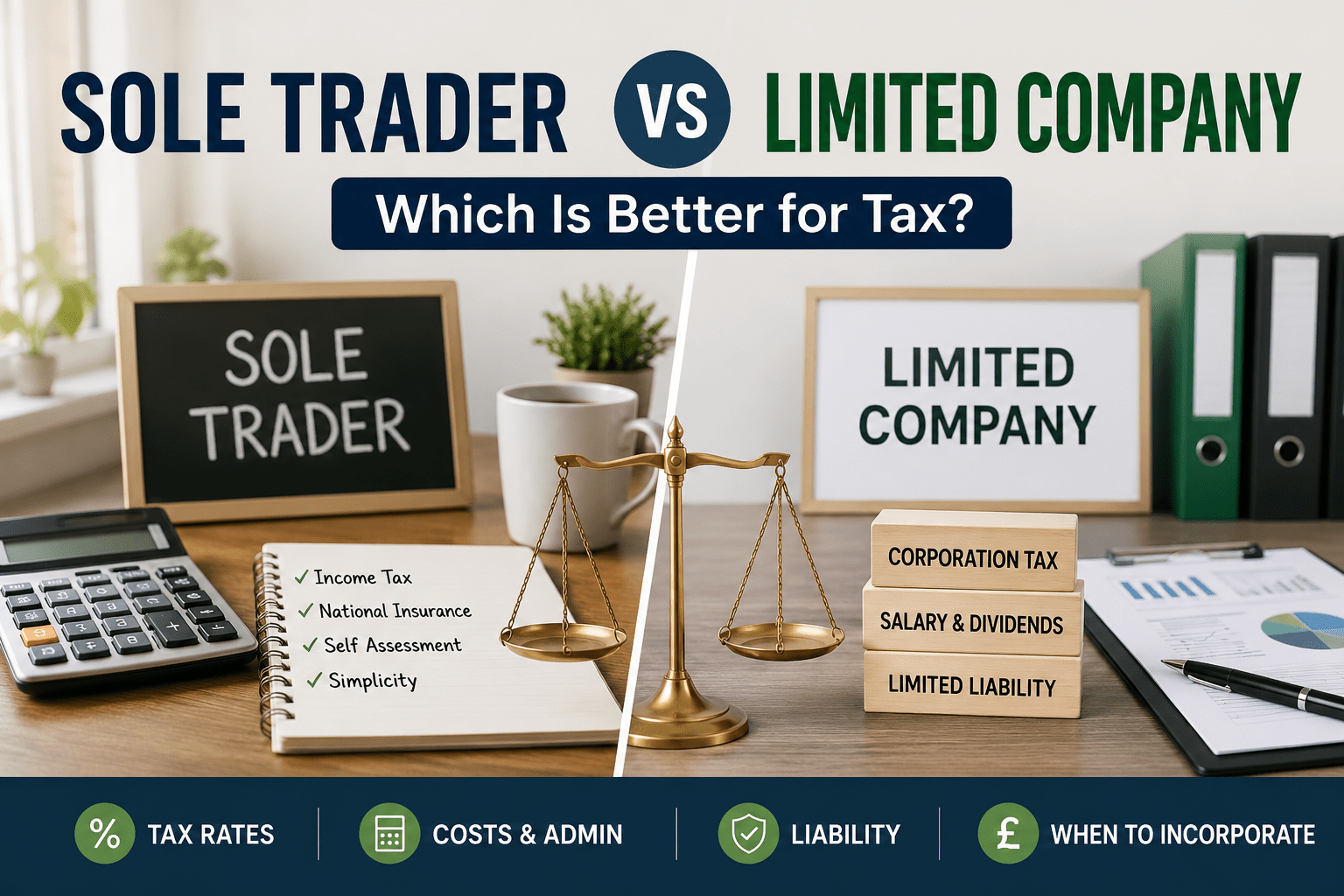
Sole Trader vs Limited Company: Which Is Better for Tax?
September 4, 2026

September 4, 2026
At lower profits, a sole trader generally pays less tax and involves far less admin. As profits grow, a limited company can become more tax-efficient because corporation tax rates are lower than the higher income tax rates, and you can split income between salary and dividends. The crossover point depends on your circumstances, but for many people it sits somewhere around £50,000 to £60,000 in annual profit.
That’s the short answer. The longer answer involves working through the numbers at different profit levels, understanding the hidden costs of running a limited company, and deciding whether the tax saving is actually worth the extra admin.
If you’re trying to decide which structure is right for you, Tax Return Assist’s small business accountants can model the numbers for your specific situation. But here’s the full comparison so you can understand the logic first.
As a sole trader, you pay income tax on your business profits and Class 4 National Insurance contributions. Your profits are added to any other income you have and taxed through the self assessment system.
For 2025/26, the income tax rates (England, Wales, and Northern Ireland) are
0% on the first £12,570 (Personal Allowance).
20% on £12,571 to £50,270.
40% on £50,271 to £125,140.
45% above £125,140.
Class 4 NICs are 6% on profits between £12,570 and £50,270, then 2% above £50,270. Compulsory Class 2 NICs were abolished from 6 April 2024.
The combined marginal rate for a sole trader in the basic rate band is 26% (20% income tax + 6% Class 4 NIC). In the higher rate band, it’s 42% (40% + 2%).
For a full breakdown of how this calculation works, see our self assessment tax calculator guide.
A limited company pays corporation tax on its profits. You as the director then extract money from the company through a combination of salary and dividends, each taxed differently.
19% on profits up to £50,000 (small profits rate).
25% on profits above £250,000 (main rate).
Marginal relief applies between £50,000 and £250,000, producing an effective marginal rate of approximately 26.5% in that band.
Director’s salary. If you pay yourself a salary, the company deducts it as an expense (reducing corporation tax), but you pay income tax and employee NICs on it, and the company pays employer NICs (currently 15% above £5,000). Many directors set their salary at around £12,570 (using the Personal Allowance) or lower to minimize NIC liability.
Dividends. After paying corporation tax, the company can distribute remaining profits as dividends. Dividend tax rates for 2025/26 are 8.75% (basic rate), 33.75% (higher rate), and 39.35% (additional rate). The first £500 of dividends is covered by the dividend allowance.
The combined effective tax rate on company profits extracted as dividends is generally lower than the sole trader rate at higher profit levels, because corporation tax at 19% plus dividend tax is less than 40% income tax plus 2% NIC.
The best way to compare is with examples at different profit levels. These assume no other income, full personal allowance available, director’s salary set at £12,570, and remaining profits extracted as dividends.
Sole trader: Income tax £3,486 + Class 4 NIC £1,045.80 = £4,531.80.
Limited company: Corporation tax at 19% on £17,430 (after salary) = £3,311.70. Dividend tax on £14,118.30 (remaining after CT) at 8.75% (after £500 allowance) = approximately £1,191. Plus employer NIC on the salary element. Total tax: approximately £4,500 to £4,800 depending on salary structure.
Verdict: roughly similar. The sole trader is simpler with almost no tax difference. At this level, the extra admin costs of a limited company eat any saving.
Sole trader: Income tax £7,486 + Class 4 NIC £2,262 = £9,748.
Limited company: Corporation tax at 19% on £37,430 = £7,111.70. Dividend tax on remaining profits at mainly 8.75% = approximately £2,300. Total: approximately £9,400 to £9,700.
Verdict: the company starts to show a small advantage, but it’s marginal. Accountancy fees for running a limited company (£1,000 to £2,000 per year more than a sole trader) could wipe out the saving.
Sole trader: Income tax £17,432 + Class 4 NIC £2,762 = £20,194.
Limited company: Corporation tax approximately £11,900 (marginal relief territory). Dividend tax on remaining profits at a mix of 8.75% and 33.75% = approximately £4,500 to £5,000. Total: approximately £17,000 to £17,500.
Verdict: the company saves approximately £2,500 to £3,000 per year. After extra accountancy costs, this is a meaningful saving.
At this level, the sole trader is paying 40% on a significant portion and losing their Personal Allowance above £100,000 (effective 60% rate in the £100k to £125k band). A limited company with a well-structured salary/dividend split can save £5,000 to £8,000 per year compared to the sole trader.
These are simplified illustrations. Your actual figures will depend on salary levels, pension contributions, other income, employer NIC costs and how much profit you leave in the company versus extracting it.
The tax comparison only tells part of the story. Running a limited company costs more in time and money.
Higher accountancy fees:
A sole trader’s annual accounts and tax return might cost £300 to £600. A limited company needs statutory accounts, a corporation tax return (CT600), a personal self assessment return, PAYE payroll, and potentially VAT returns. Total: £1,000 to £2,500 per year. The extra £700 to £1,900 is a real cost that reduces your net saving.
Companies House filing. You must file annual accounts and a confirmation statement with Companies House every year. The accounts are public. Anyone can see your company’s turnover, profit, and balance sheet. If you value financial privacy, this is a significant downside.
Payroll administration. If you pay yourself a salary, you need to run payroll (even if it’s just for one person). That means RTI submissions to HMRC every pay period. Most directors outsource this to their accountant, which is part of why the fees are higher.
Director’s responsibilities. You have legal duties as a company director under the Companies Act 2006. Filing deadlines are strict. Late filing penalties from Companies House are separate from (and additional to) any HMRC penalties.
Closing the company is not free. If you decide to stop trading, winding up a limited company involves either a formal dissolution or a liquidation, depending on the circumstances. As a sole trader, you simply stop trading and file your final tax return.
Personal liability. A sole trader has unlimited personal liability. If the business can’t pay its debts, creditors can come after your personal assets (your house, savings, and car). A limited company has separate legal personality, so in most cases your personal assets are protected. But this protection isn’t absolute. Banks often require personal guarantees for company loans, and directors can be made personally liable for fraudulent or wrongful trading.
Pension contributions. A limited company can make employer pension contributions on your behalf. These are a tax-deductible expense for the company and don’t count as a taxable benefit for you (within the annual allowance). This can be a very efficient way to extract profits. As a sole trader, pension contributions still get tax relief, but the mechanics are different.
Mortgages. Some mortgage lenders find sole trader income easier to assess than limited company income (especially if you use a salary/dividend split). Others prefer the structure of a limited company with formal accounts. This varies widely between lenders. If you’re planning to apply for a mortgage in the next year or two, ask your broker before changing your business structure.
There’s no single answer, but these are the situations where incorporation typically starts to make financial sense:
Your annual profits are consistently above £50,000 to £60,000, and you expect them to stay there. You don’t need to extract all profits immediately (leaving money in the company defers dividend tax). You want the liability protection of a limited company. Your clients or industry expect you to operate through a company. You want to make large employer pension contributions.
Situations where staying as a sole trader usually makes more sense:
If you’re earning enough to consider incorporation, it’s worth getting advice specific to your numbers. The self-employed accountant team at Tax Return Assist can model the sole trader vs limited company comparison for your actual income and expenses.
If you decide to incorporate, the process involves:
1. Registering a new limited company at Companies House (can be done online for £12, takes about 24 hours).
2. Opening a business bank account in the company’s name.
3. Registering the company for corporation tax with HMRC (within 3 months of starting to trade).
4. Setting up payroll to pay yourself a director’s salary.
5. Transferring business assets to the company if applicable.
6. Notifying HMRC that you’ve stopped trading as a sole trader.
7. Filing your final sole trader self assessment return for the period up to the date you stopped trading.
You can continue to trade as a sole trader while setting up the company, but there should be a clean cut-off date. Running both structures simultaneously for the same business creates complications.
The right answer depends on your profits, your plans, your attitude to admin, and your personal circumstances. A comparison that saves one person £3,000 per year might cost another person money once accountancy fees and complexity are factored in.
Tax Return Assist advises sole traders and limited company directors across Essex and London. Their accountants can model both scenarios using your real numbers and tell you exactly where the break-even point falls. Call 02039377911, email contact@taxreturnassist.co.uk or use the online quote form.
Disclaimer
Disclaimer: This article is for general information purposes only and does not constitute professional financial, tax, or legal advice. Tax rules and rates can change, and individual circumstances can affect the amount of tax payable. Always check the latest HMRC guidance or speak to a qualified accountant or tax adviser before making tax decisions. Tax Return Assist accepts no liability for actions taken based on the information contained in this article.

Expert tax & accountancy services for individuals, businesses, and contractors across the UK — fixed monthly or one-time fees. Trusted for our all-inclusive service plans.
Tax Return Assist Ltd is a registered Companies House Authorised ACSP, professionally regulated under the Institute of Financial Accountants (IFA).
Leave a comment