


October 6, 2026

October 6, 2026
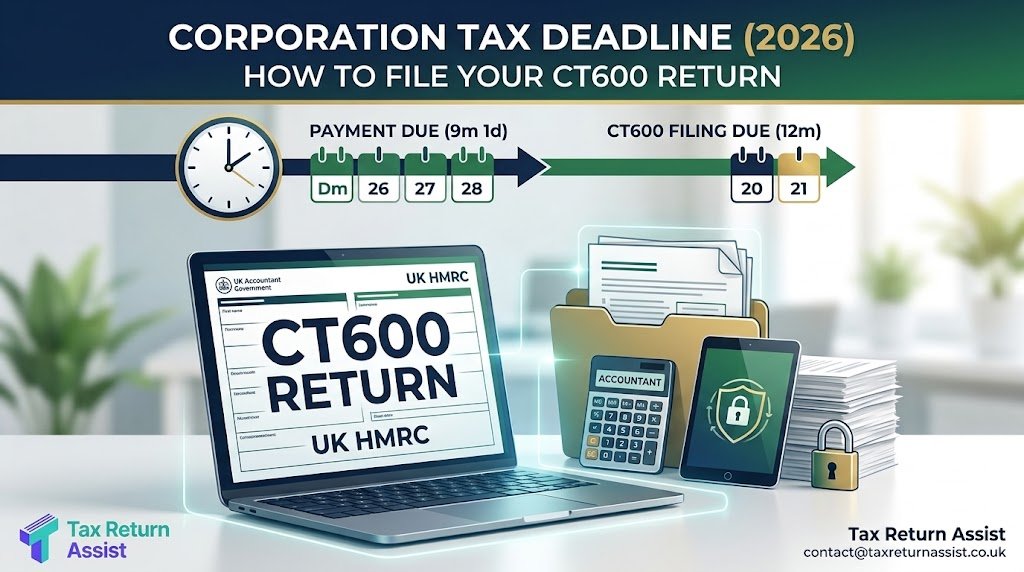
The corporation tax return (CT600) must be filed with HMRC within 12 months of the end of your accounting period. The corporation tax payment is due earlier: 9 months and 1 day after your accounting period ends. For a company with a 31 March 2026 year end, that means paying by 1 January 2027 and filing the return by 31 March 2027.
These deadlines don’t move. HMRC doesn’t grant extensions because your accountant is busy or because you haven’t finished your accounts yet. Late filing triggers automatic penalties. Late payment triggers interest from day one.
If your deadline is approaching and you haven’t started, Tax Return Assist’s small business accountants can prepare and file your CT600 quickly. But if you want to understand the full timeline, here’s every deadline that matters.
Every limited company faces 3 annual filing deadlines. They’re all calculated from your accounting reference date (the end of your financial year).
Deadline 1: Pay corporation tax 9 months and 1 day after your accounting period ends. This is the earliest deadline and the one most people focus on because money is leaving the account.
Deadline 2: File annual accounts with Companies House: 9 months after your accounting period ends. This is the same month as the payment deadline, so they often land within days of each other. Our guide to filing company accounts with Companies House covers this in full.
Deadline 3: File the CT600 with HMRC: 12 months after your accounting period ends. This is the latest deadline, giving you 3 extra months after the payment to finalize and submit the return.
Quick reference for common year-end dates:
31 March 2026 year-end: pay by 1 January 2027. Companies House accounts by 31 December 2026. CT600 by 31 March 2027.
30 June 2026 year-end: pay by 1 April 2027. Companies House accounts by 31 March 2027. CT600 by 30 June 2027.
31 December 2025 year-end: pay by 1 October 2026. Companies House accounts by 30 September 2026. CT600 by 31 December 2026.
You can check your exact deadlines by searching your company on the Companies House website or logging into your HMRC business tax account.
New companies get more time for their first filing, but the dates can catch you out.
First accounts: due at Companies House 21 months after incorporation.
First CT600: due at HMRC 12 months after the end of your first accounting period.
First tax payment: due 9 months and 1 day after the end of your first accounting period.
Your first accounting period can be longer than 12 months (up to 18 months). If it’s longer than 12 months, you’ll need to file 2 CT600s covering the period because HMRC doesn’t accept a single return covering more than 12 months.
Example: you incorporated on 1 May 2025 with a 31 March year-end. Your first accounting period runs from 1 May 2025 to 31 March 2026 (11 months). The first CT600 is due by 31 March 2027. First payment due by 1 January 2027. First Companies House accounts due by 1 February 2027 (21 months from incorporation).
The CT600 is filed online using commercial software. If you’re not sure what a CT600 actually contains, our plain-English guide to the CT600 explains every section.
Step 1. Finalize your company accounts. The statutory accounts (balance sheet, profit and loss, notes) must be prepared before you can complete the CT600. The return is based on the figures in these accounts.
Step 2. Calculate the tax adjustments. Start with the accounting profit and adjust for tax purposes. Add back disallowable expenses (depreciation, entertaining, certain provisions). Deduct capital allowances on qualifying assets. Apply any loss relief. The result is your taxable profit.
Step 3. Complete the CT600 in commercial software. The return must be in iXBRL format. Professional accounting software (Xero, Sage, TaxCalc, CCH, and Digita) generates this automatically. The statutory accounts in iXBRL format are attached to the return.
Step 4. Submit to HMRC. The software sends the completed CT600 and attached accounts to HMRC electronically. You receive an acknowledgement with a reference number. Keep it as proof of filing.
HMRC’s joint filing service closed on 31 March 2026. You can no longer file the CT600 and Companies House accounts together through HMRC. They’re now separate submissions through separate systems.
Corporation tax is paid through HMRC’s online payment system. The payment reference is your company’s UTR (10 digits) followed by the accounting period end date.
Online banking or faster payment: pay directly from the company bank account using the payment reference. Clears same day or next day. This is the fastest and most common method.
Direct Debit: set up through the company’s HMRC business tax account. Takes 5 working days for the first payment, so don’t leave it until the deadline day.
Debit or corporate credit card: through the HMRC website. Personal credit cards aren’t accepted.
CHAPS: for same-day payment through your bank. Usually carries a fee (£20 to £30) but guarantees same-day clearance if you’re right on the deadline.
Pay on time. Interest starts accumulating from the day after the deadline. There’s no grace period and no rounding. If you’re 1 day late, interest is charged for that day.
HMRC’s penalty structure for late CT600 filing escalates over time:
1 day late: £100 automatic penalty.
3 months late: another £100.
6 months late: HMRC estimates your tax bill and charges 10% of the unpaid tax on top of the £200 already owed.
12 months late: another 10% of the unpaid tax.
If the company has filed late 3 times in a row, the £100 fixed penalties increase to £500 each. So a serial late filer pays £1,000 in fixed penalties before the percentage charges even begin.
These penalties are assessed on the company. They reduce the company’s profits and come out of money that could have been distributed as dividends or reinvested.
HMRC charges interest on unpaid corporation tax from the day after the payment deadline. The current rate is the Bank of England base rate plus 4 percentage points (7.75% as of 2026).
On a £20,000 tax bill, that’s roughly £4.25 per day. About £127 per month. It compounds, so the longer you leave it, the faster it grows.
Unlike self assessment, there are no flat percentage surcharges for late corporation tax payment. It’s purely interest-based. But the interest rate is high enough to make late payment expensive.
If you can’t pay on time, contact HMRC before the deadline to discuss a time-to-pay arrangement. They’ll set up monthly installments. Interest still runs on the balance, but arranging it proactively is far better than ignoring the deadline and waiting for HMRC to chase you.
Companies with annual taxable profits above £1.5 million (or £1.5 million divided by the number of associated companies) must pay corporation tax in quarterly instalments rather than a single payment.
The installments are due in months 7, 10, 13, and 16 of the accounting period. For a company with a 31 March year-end, that’s roughly October, January, April, and July.
Most small limited companies don’t hit this threshold, so the standard 9-month-and-1-day payment deadline applies. If your company is growing toward this level, your accountant should flag when quarterly installments become relevant.
Yes. You have 12 months from the filing deadline to amend your CT600. Since the filing deadline is 12 months after your year end, the amendment window is effectively 24 months from the end of the accounting period.
Common reasons to amend: you discovered an expense you forgot to claim, a capital allowance calculation was wrong, you received a refund or credit note after filing, or your accountant identified a relief that was missed.
HMRC can also open an inquiry into your CT600 within 12 months of the filing date. If they find errors, they’ll amend the return and issue a revised tax calculation. Getting the return right the first time avoids this.
Assuming a 31 March year-end, here’s how the year typically flows:
1 April: the new accounting period begins. Start tracking income, expenses, and transactions.
31 March (following year): accounting period ends. Gather all records for the year-end.
April to September: the accountant prepares statutory accounts and CT600.
31 December (9 months): Companies House accounts deadline.
1 January (9 months + 1 day): corporation tax payment deadline.
31 March (12 months): CT600 filing deadline with HMRC.
The smart approach: get your records to your accountant within a month of your year-end. That gives them 5 to 6 months to prepare everything, leaving a comfortable buffer before any deadline.
Tax Return Assist prepares and files CT600 returns for limited companies across Essex and London. Their accountants handle statutory accounts, corporation tax calculations, capital allowances, HMRC submission, and payment reminders. Everything is filed on time every year.
Call 02039377911, email contact@taxreturnassist.co.uk or use the online quote form.
Disclaimer: This article is for general information purposes only and does not constitute professional financial, tax, or legal advice. Tax rules and rates can change, and individual circumstances can affect the amount of tax payable. Always check the latest HMRC guidance or speak to a qualified accountant or tax adviser before making tax decisions. Tax Return Assist accepts no liability for actions taken based on the information contained in this article.

Expert tax & accountancy services for individuals, businesses, and contractors across the UK — fixed monthly or one-time fees. Trusted for our all-inclusive service plans.
Tax Return Assist Ltd is a registered Companies House Authorised ACSP, professionally regulated under the Institute of Financial Accountants (IFA).


