


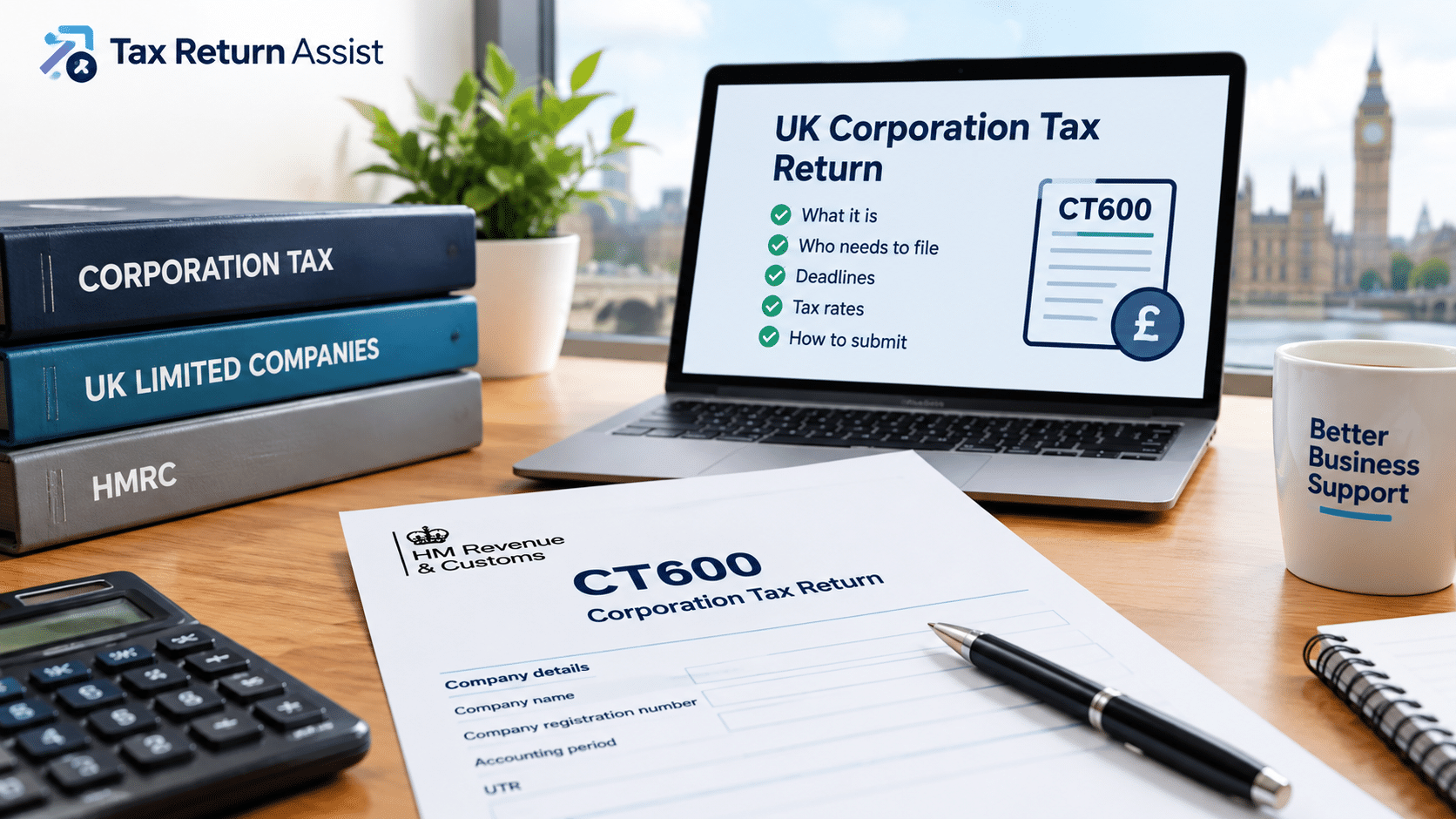
What Is a CT600 Corporation Tax Return? Simple Explanation
October 3, 2026

October 3, 2026
A CT600 is the tax return that every UK limited company files with HMRC to report its taxable profits and calculate how much corporation tax it owes. It covers one accounting period (usually 12 months), must be filed within 12 months of the accounting period end, and the tax itself must be paid within 9 months and 1 day.
Think of it as the company equivalent of a self assessment return. Where a sole trader files a personal tax return to HMRC, a limited company files a CT600. The form is different, the tax rates are different, and the deadlines are different, but the purpose is the same: tell HMRC what you earned and pay what you owe.
Below is a plain-English explanation of everything the CT600 covers. If you’d rather have an accountant handle it, Tax Return Assist’s small business accountants prepare and file CT600s for limited companies across Essex and London.
Every UK limited company that’s registered with HMRC for corporation tax. This includes active trading companies, dormant companies (they file a nil return), companies that made a loss, and companies with no corporation tax to pay.
If HMRC has sent your company a “notice to deliver a company tax return,” you must file. Even if the company hasn’t traded. Even if you’re winding it down. The obligation stands until HMRC removes it.
Sole traders don’t file a CT600. They file a personal self assessment return instead. If you’re not sure which structure you’re operating under, our guide to sole trader vs. limited company explains the differences.
The CT600 is a detailed form, but for a small limited company, only certain sections apply. Here’s what’s typically involved:
Company details: Company name, registered number, UTR (the company’s Unique Taxpayer Reference, different from any personal UTR), accounting period dates, and the company’s registered office address.
Turnover: The company’s total income for the accounting period. For most small companies, this comes directly from the profit and loss account.
Trading profits: Turnover minus allowable business expenses. This is the starting point for the tax calculation, but it gets adjusted.
Capital allowances: Tax relief on qualifying assets the company purchased during the period (equipment, vehicles, machinery, certain fixtures). Capital allowances are calculated for tax purposes and may differ from the depreciation shown in the company accounts. The annual investment allowance lets most companies deduct the full cost of qualifying assets up to £1 million.
Disallowable expenses: Certain expenses in the company accounts can’t be deducted for tax purposes. The most common: client entertaining, depreciation (replaced by capital allowances), certain provisions, and fines or penalties. The CT600 adds these back to the profit figure.
Income from other sources: Bank interest, investment income, property income, and any other non-trading income the company received.
Losses: If the company made a loss, the CT600 reports it. Losses can generally be carried back 1 year or carried forward indefinitely against future profits, reducing tax in other periods. Getting loss relief right can save a company significant tax.
Director loans: If the company has lent money to a director (or the director has overdrawn their loan account), section 455 tax may be due at 33.75% of the outstanding balance. This gets reported on the CT600 and is repayable when the loan is repaid.
Tax calculation: The final section calculates the corporation tax due based on the adjusted taxable profits and the applicable rate.
19% (small profits rate): applies to companies with taxable profits up to £50,000.
25% (main rate): applies to companies with taxable profits above £250,000.
Marginal relief applies to companies with profits between £50,000 and £250,000. The effective marginal rate in this band is approximately 26.5%. This means each additional pound of profit above £50,000 is taxed at a higher effective rate until you reach £250,000.
These thresholds are divided by the number of associated companies. If you control 2 companies, the small profits threshold drops to £25,000 each. This prevents directors from splitting profits across multiple companies to stay in the lower band.
There are 2 separate deadlines, and they’re easy to confuse.
Corporation tax payment deadline: 9 months and 1 day after the end of the accounting period. If your accounting period ends 31 March 2026, you must pay by 1 January 2027. This is the money deadline. Pay late, and HMRC charges interest from day one.
CT600 filing deadline: 12 months after the end of the accounting period. Using the same example, the return must be filed by 31 March 2027. This is the paperwork deadline. File late and HMRC charges penalties.
Notice the gap: you have to pay the tax 3 months before the return is due. This means you need to calculate (or estimate) your tax bill before you’ve finalized and filed the CT600. Most accountants prepare the return early enough to meet both deadlines together.
Late filing penalties:
1 day late: £100.
3 months late: another £100.
6 months late: HMRC estimates your tax and charges 10% of the unpaid amount.
12 months late: another 10% of unpaid tax.
If your return is late 3 times in a row, the initial £100 penalties increase to £500 each.
Late payment: HMRC charges interest on unpaid corporation tax from the day after the payment deadline. The rate is the Bank of England base rate plus 4 percentage points (currently 7.75%). There’s no flat penalty for late payment, just compounding interest.
These are separate from Companies House penalties for late accounts filing. A company that files both late faces penalties from both HMRC and Companies House at the same time.
CT600s must be filed online. Paper filing is not accepted for corporation tax returns.
Step 1. Prepare the company accounts. The CT600 is based on the figures in your statutory accounts (profit and loss, balance sheet). The accounts need to be finalized before you can prepare the return.
Step 2. Make the tax adjustments. Start with the profit from the accounts and adjust it for tax purposes: add back disallowable expenses, deduct capital allowances, and apply any loss relief or other tax adjustments. This gives you the taxable profit.
Step 3. Complete the CT600 form. Using commercial software that produces the return in iXBRL format. The software generates the CT600, computes the tax, and packages the accounts for submission. Common packages include Xero, Sage, and TaxCalc, and the professional tools accountants use.
Step 4. Attach the accounts. The statutory accounts in iXBRL format must be submitted alongside the CT600. The software handles this formatting.
Step 5. Submit to HMRC online. The software sends the CT600 and attached accounts to HMRC. You receive an acknowledgement with an HMRC reference number. Keep it.
HMRC’s own joint filing service (which previously allowed filing of accounts and the CT600 together) closed on 31 March 2026. The CT600 is now filed separately using commercial software.
They serve different purposes, go to different organizations, and have different deadlines.
Companies House accounts are the statutory accounts filed for public record. They show the company’s financial position. The deadline is 9 months after the year-end. They go to Companies House.
The CT600 is the tax return filed to calculate and pay corporation tax. It uses the same underlying figures but includes additional tax calculations. The deadline is 12 months after the year-end. It goes to HMRC.
Both are required every year. Most accountants prepare them at the same time because the numbers feed into each other. The company accounts are prepared first, then the CT600 adjustments are made on top.
Legally, yes. The director is responsible for the company’s tax affairs. But practically, the CT600 involves tax adjustments, capital allowance calculations, and compliance with corporation tax legislation that most directors aren’t trained in.
Common errors that trigger HMRC enquiries: incorrectly calculated capital allowances, missing disallowable expenses (especially depreciation and entertaining), incorrect treatment of director loans, failing to claim loss relief when available, and errors in the marginal relief calculation for companies with profits between £50,000 and £250,000.
An accountant who prepares CT600s regularly knows what HMRC looks for and where the common mistakes sit. The fee (typically £500 to £1,500 for a small company, usually combined with the annual accounts) is generally less than the cost of a single error.
It depends. If HMRC has issued a notice to deliver a return, then yes, even if the company is dormant. You file a nil return showing zero income and zero tax.
If the company has been dormant since incorporation and you’ve told HMRC it’s dormant, HMRC may not issue a notice to deliver. In that case, no CT600 is required. But you still need to file dormant accounts with Companies House.
Tax Return Assist prepares and files CT600 returns for limited companies across Essex and London. Their accountants handle the full process: statutory accounts, corporation tax calculations, capital allowances, loss relief, and submission to HMRC. All within the deadline, every year.
Call 02039377911, email contact@taxreturnassist.co.uk or use the online quote form.
Disclaimer: This article is for general information purposes only and does not constitute professional financial, tax or legal advice. Tax rules and rates can change, and individual circumstances can affect the amount of tax payable. Always check the latest HMRC guidance or speak to a qualified accountant or tax adviser before making tax decisions. Tax Return Assist accepts no liability for actions taken based on the information contained in this article.

Expert tax & accountancy services for individuals, businesses, and contractors across the UK — fixed monthly or one-time fees. Trusted for our all-inclusive service plans.
Tax Return Assist Ltd is a registered Companies House Authorised ACSP, professionally regulated under the Institute of Financial Accountants (IFA).
Leave a comment