


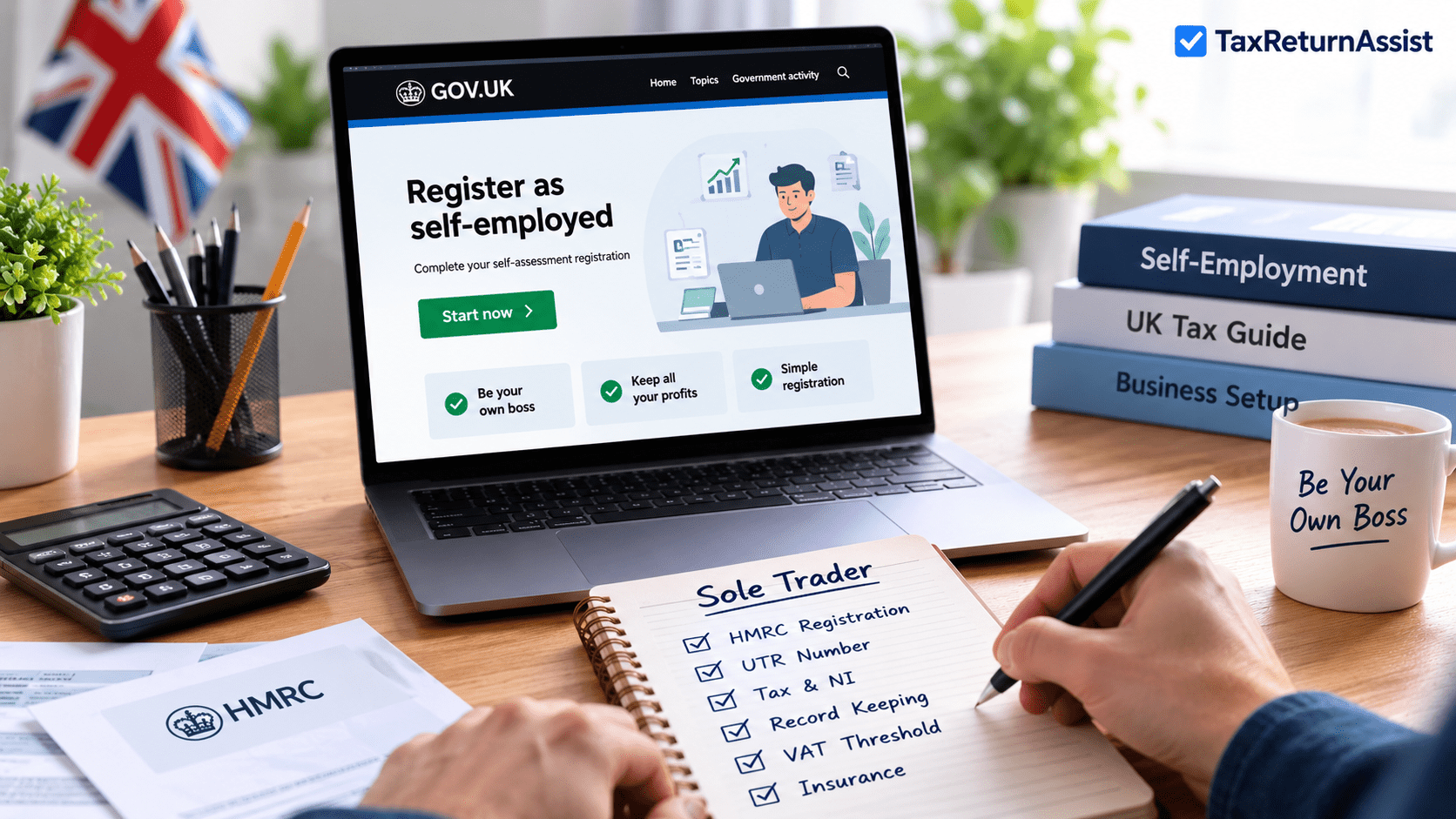
How to Become a Sole Trader in the UK: Complete 2026 Guide
September 1, 2026

September 1, 2026
You become a sole trader by registering with HMRC for self assessment. There’s no Companies House filing, no formation paperwork and no registration fee. You go to GOV.UK, tell HMRC you’re self-employed, and wait for your Unique Taxpayer Reference (UTR) to arrive in the post. The whole process takes about 15 minutes online, plus 10 to 15 working days for the UTR to reach you.
A sole trader is the simplest business structure in the UK. You and your business are legally the same entity. You keep all the profits, you make all the decisions and you carry all the liability. Around 3.5 million people in the UK operate as sole traders.
Below is everything you need to know to get started. If you’d rather have someone set everything up for you, Tax Return Assist’s self-employed accountants handle HMRC registration, bookkeeping and tax returns for sole traders across Essex and London.
A sole trader is an individual running a business on their own. You don’t have a separate legal identity from your business. If your business owes money, you personally owe that money. If your business gets sued, you personally get sued.
This is different from a limited company, where the company is a separate legal entity and your personal liability is generally limited to what you’ve invested.
Despite the name, being a sole trader doesn’t mean you work alone. You can hire employees, take on subcontractors and grow as large as you want. The “sole” part just means there’s one owner.
Common sole trader businesses: freelance writers, graphic designers, plumbers, electricians, personal trainers, tutors, photographers, consultants, market traders, cleaners, IT contractors and delivery drivers. If you earn money independently and you’re not operating through a limited company or partnership, you’re probably a sole trader.
Step 1. Check you’re actually self-employed. HMRC has an employment status checker on GOV.UK. The key indicators: you set your own hours, provide your own equipment, can turn down work, invoice for your services and aren’t entitled to employee benefits like sick pay or holiday pay. If a company controls how, when and where you work, you might actually be an employee, and registering as a sole trader wouldn’t be correct.
Step 2. Go to GOV.UK and register as a sole trader. Search “register as sole trader” on GOV.UK. Select “I’m self-employed” and log in with your Government Gateway account (or create one if you don’t have one). You’ll need your National Insurance number, your name, date of birth, address, the date you started trading, what your business does and your trading name.
Step 3. Wait for your UTR. HMRC posts your 10-digit Unique Taxpayer Reference to your home address. This usually takes 10 to 15 working days in the UK, or up to 21 days if you’re abroad. This number identifies you in HMRC’s system for life.
Step 4. Add self assessment to your Government Gateway account. Log back in, select “add a tax” and choose self assessment. Enter your UTR when prompted. HMRC may send a separate activation code by post. Enter it within 28 days.
That’s it. You’re now registered as a sole trader with HMRC. No fee. No lawyer needed. No Companies House involvement.
Our step-by-step registration guide covers the Government Gateway setup in more detail if you need it.
The deadline is 5 October following the end of the tax year in which you started trading. If you started any time between 6 April 2025 and 5 April 2026, you must register by 5 October 2026.
But there’s no penalty for registering early, and there’s no advantage to waiting. Register as soon as you start trading. It gets you your UTR faster and gives you more time to prepare for your first tax return.
If you register late, HMRC may charge a penalty. More importantly, a late registration compresses the time you have to get your UTR, set up your records and file your first return. That’s how people end up missing the 31 January filing deadline and paying a £100 late filing penalty on top.
No. You can trade under your own name. “Sarah Jones” is a perfectly valid trading name for a sole trader.
If you want to use a different name (“SJ Creative” or “Jones Plumbing”), you can. No registration is required for a trading name. Just start using it on your invoices, website and marketing.
There are some restrictions. Your trading name can’t include “limited,” “Ltd,” “LLP” or “PLC” because those imply a different business structure. It also can’t include certain sensitive words (“royal,” “council,” “authority”) without permission.
Important: even if you trade under a business name, your real name must appear on all formal business documents, invoices, contracts and official correspondence. An invoice from “SJ Creative” needs to include “Sarah Jones, Sole Trader” somewhere on it.
Sole trader trading names are not protected. Anyone else can trade under the same name. If you want exclusive rights to a name, you’d need to register a trademark or form a limited company at Companies House.
Sole traders pay income tax on their profits (not their turnover) and Class 4 National Insurance contributions.
For 2025/26, the income tax rates for England, Wales and Northern Ireland are:
0%: first £12,570 (Personal Allowance).
20%: £12,571 to £50,270.
40%: £50,271 to £125,140.
45%: above £125,140.
Class 4 NICs are 6% on profits between £12,570 and £50,270, then 2% above £50,270. Compulsory Class 2 NICs were abolished from 6 April 2024, though voluntary contributions may be possible to protect state pension entitlement.
Our self assessment tax calculator guide has worked examples showing exactly how much you’d owe at different income levels.
You report your income and pay your tax through self assessment. The online filing deadline is 31 January following the end of the tax year. For the 2025/26 tax year, that means 31 January 2027.
HMRC requires sole traders to keep records of all business income and expenses. You must retain these for at least 5 years after the 31 January submission deadline for the relevant tax year.
At a minimum, keep:
All sales invoices or records of income received. Bank statements for your business account. Receipts for every business expense you intend to claim. Mileage logs if you’re claiming business travel. Records of any assets purchased or sold for the business.
You can keep paper records or digital records. HMRC accepts both. But digital is easier to organise, harder to lose and required if you’ll eventually need to comply with Making Tax Digital.
If record-keeping isn’t your strength, a bookkeeping service can handle it for a fixed monthly fee. Getting this right from day one saves hours of pain at tax return time.
There’s no legal requirement for sole traders to have a separate business bank account. But it’s one of the most useful things you can do.
With separate accounts, every transaction in your business account is a business transaction. No need to scroll through 12 months of personal spending to identify which entries are business-related. Reconciliation takes minutes instead of hours. Your accountant charges less because the records are clean.
Some personal bank accounts don’t permit business use in their terms and conditions. Check yours. Most business accounts from high street banks cost £5 to £15 per month, and several digital banks (Starling, Tide, Mettle) offer free business accounts for sole traders.
Only if your taxable turnover exceeds £90,000 in any 12-month rolling period. Below that threshold, VAT registration is optional.
Voluntary registration can make sense if most of your customers are VAT-registered businesses (they can reclaim the VAT you charge, so it doesn’t cost them anything). It also lets you reclaim VAT on your own business purchases.
If most of your customers are individuals (who can’t reclaim VAT), registering voluntarily means your prices effectively increase by 20%. For many sole traders below the threshold, staying unregistered is the better option.
VAT registration is separate from self assessment registration. You register for VAT through your Government Gateway account or by post.
There’s no blanket legal requirement, but some types of insurance are essential depending on your trade.
Employers’ liability insurance: legally required if you hire any employees. Must be at least £5 million and from an authorised insurer.
Public liability insurance: not legally required for most sole traders, but strongly recommended if you visit clients’ premises, work with the public or provide physical services. If you damage someone’s property or they’re injured because of your work, this covers the claim.
Professional indemnity insurance: important for consultants, IT contractors, designers, accountants and anyone providing advice or professional services. It covers claims arising from errors, omissions or negligent advice.
Many clients and contracts will require you to hold specific insurance before they’ll work with you. Check what your industry expects.
Sole trader is almost always the right starting point. It’s simpler, cheaper and involves far less admin. You can always incorporate later if it makes financial sense.
The main reasons people incorporate:
Tax efficiency at higher profits. Once your profits consistently exceed £50,000 to £60,000, the combination of corporation tax (25%) and dividend tax can work out cheaper than income tax and NICs as a sole trader. But this depends heavily on your specific circumstances, so get professional advice before making the switch.
Limited liability. A limited company separates your personal assets from business debts. If your business carries significant risk (large contracts, physical liability, debt), this protection matters.
Client expectations. Some clients and agencies prefer to work with limited companies. In certain sectors (IT contracting, finance), operating through a company is the industry norm.
If you’re just starting out and your expected profits are under £50,000, sole trader is almost certainly the right structure. Keep things simple until there’s a genuine financial reason to change.
From 6 April 2026, Making Tax Digital for Income Tax became mandatory for sole traders and landlords whose qualifying income from self-employment and/or property exceeds £50,000. Qualifying income means gross receipts before expenses. PAYE employment income doesn’t count towards this threshold.
If you’re above the threshold, you’ll need MTD-compatible software (Xero, FreeAgent, QuickBooks or similar) to keep digital records and send quarterly updates to HMRC, plus a final declaration at year end.
The threshold drops to £30,000 from April 2027 and £20,000 from April 2028. Even if you’re below £50,000 now, choosing MTD-compatible software from the start means you won’t need to switch later.
If you’re just starting out with low income, the traditional annual self assessment return still applies for now.
Register with HMRC for self assessment (GOV.UK). Wait for your UTR to arrive by post. Set up a Government Gateway account and link your UTR. Open a separate business bank account. Choose an accounting method (cash basis for most new sole traders). Set up a simple record-keeping system or accounting software. Understand your tax deadlines (31 January for online filing, 31 July for second payment on account). Put aside 25% to 30% of your profits for tax. Check whether you need business insurance. Consider whether you need to register for VAT (only if turnover approaches £90,000).
Becoming a sole trader is straightforward. Staying on top of the tax obligations is where most people need support. Tax Return Assist works with sole traders across Essex and London, handling everything from HMRC registration to annual tax returns.
Their accountant for self-employed service covers registration, bookkeeping, self assessment filing and year-round tax advice. Call 02039377911, email contact@taxreturnassist.co.uk or use the online quote form to get started.
Disclaimer
Disclaimer: This article is for general information purposes only and does not constitute professional financial, tax or legal advice. Tax rules and rates can change, and individual circumstances can affect the amount of tax payable. Always check the latest HMRC guidance or speak to a qualified accountant or tax adviser before making tax decisions. Tax Return Assist accepts no liability for actions taken based on the information contained in this article.

Expert tax & accountancy services for individuals, businesses, and contractors across the UK — fixed monthly or one-time fees. Trusted for our all-inclusive service plans.
Tax Return Assist Ltd is a registered Companies House Authorised ACSP, professionally regulated under the Institute of Financial Accountants (IFA).
Leave a comment