


When should a limited company file its accounts and tax return?
November 9, 2026

November 9, 2026
Every UK limited company has 3 separate filing obligations with 2 different bodies. Annual accounts go to Companies House. The corporation tax payment and the Company Tax Return (CT600) go to HMRC. All 3 run on different deadlines, and confusing them is one of the most common mistakes directors make.
The part that trips people up most: the corporation tax payment is due before the tax return that calculates it. If you wait until you’ve filed your CT600 to pay the bill, you’re already late. This guide sets out every deadline in the order they actually fall, with worked examples so you can map them to your own year end.
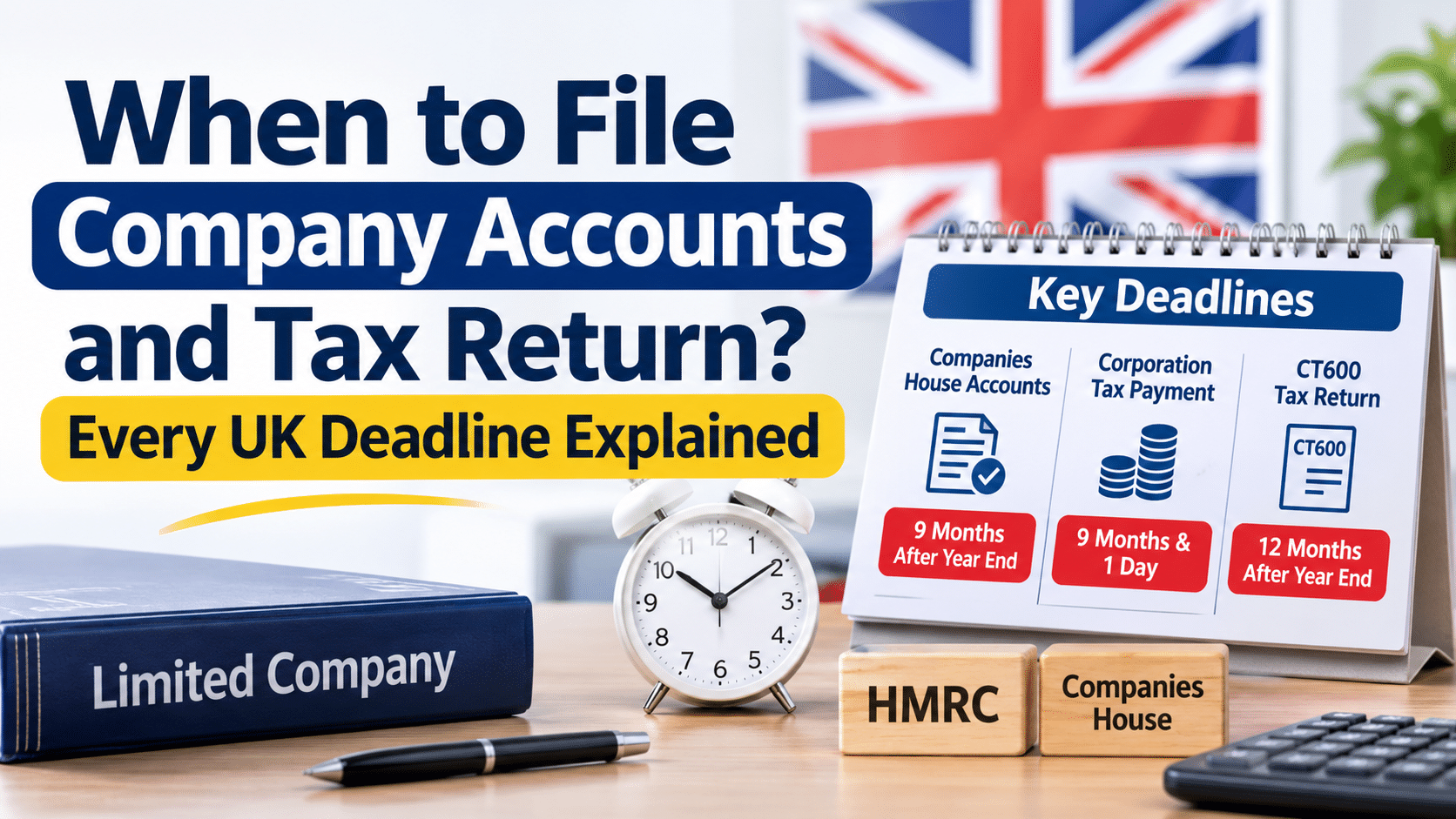
For a standard 12 month accounting period, the deadlines work like this. Companies House annual accounts are due 9 months after your accounting reference date. Your corporation tax payment to HMRC is due 9 months and 1 day after the end of your accounting period. Your CT600 (Company Tax Return) is due to HMRC 12 months after the accounting period ends.
So for a company with a 31 March 2026 year end, the deadlines fall as follows. Companies House accounts: 31 December 2026. Corporation tax payment: 1 January 2027. CT600 filing: 31 March 2027. Notice how the payment deadline lands 1 day after the Companies House accounts deadline. They cluster together but they’re filed with different bodies for different purposes.
These deadlines operate independently. Filing your accounts with Companies House doesn’t mean you’ve dealt with HMRC. Paying your corporation tax doesn’t mean your CT600 is filed. Each one must be completed separately, and each carries its own penalties if you miss it.
New companies get more time for their first set of accounts. Instead of the standard 9 months, you have 21 months from your date of incorporation to file your first accounts with Companies House. Your first accounting period can cover up to 18 months.
For example, if you incorporated on 1 February 2025 with a year end of 31 January 2026, your first Companies House accounts are due by 1 November 2026 (21 months from incorporation). From the second year onwards, the deadline shortens to the standard 9 months after year end.
There’s another wrinkle for new companies. Because a corporation tax accounting period can’t exceed 12 months, your first year may need to be split into 2 separate CT600 returns. If your first accounting period covers 15 months, HMRC treats it as one 12 month period and one 3 month period, each requiring its own return. Your accountant should flag this for you, but it catches a lot of first time directors off guard. For more on this, see our guide on what is a CT600 and how to file it.
Private limited companies must file annual accounts within 9 months of their accounting reference date (ARD). Your ARD is usually the last day of the month in which you incorporated, unless you’ve changed it. You can check your company’s ARD and current filing deadline on the Companies House register.
Companies House doesn’t send reminders. Or rather, it might send an email prompt, but there’s no guarantee and the absence of a reminder is never accepted as a reason for late filing. It’s your responsibility as a director to know your deadline and meet it.
You can’t request an extension. Companies House doesn’t grant individual deadline extensions, no matter what the circumstances. If you know the accounts will be late, file them late rather than not at all, because penalties escalate the longer you delay. And from 1 April 2026, HMRC’s CATO joint filing service closed permanently, so you now need to file Companies House accounts separately through their web filing service or through commercial software.
For a full walkthrough of the filing process, see our guide on how to file company accounts with Companies House.
Companies House penalties are automatic. There’s no warning, no grace period and no appeal on the basis of a reasonable excuse. The penalty is triggered the moment your filing passes the deadline.
For private limited companies, the penalty is £150 if you’re up to 1 month late, £375 between 1 and 3 months late, £750 between 3 and 6 months late and £1,500 if you’re over 6 months late. If your accounts are late 2 years in a row, every one of those penalties doubles. A company that’s over 6 months late for a second consecutive year faces a £3,000 fine from Companies House alone.
And Companies House has the power to start strike off proceedings against companies that consistently fail to file. Being struck off means your company is removed from the register and ceases to exist as a legal entity. Any assets it held become Crown property.
Corporation tax must be paid to HMRC 9 months and 1 day after the end of your accounting period. For a 31 March 2026 year end, that means payment is due by 1 January 2027. You pay before you file the return.
For 2025/26, the rates are 19% (small profits rate) on taxable profits up to £50,000 and 25% (main rate) on profits above £250,000. Marginal relief applies to profits between those two figures. If your company made a loss or has no tax liability, you still need to file the CT600, just without a payment.
Late payment interest currently runs at 7.75% and accrues from the day after the payment deadline. HMRC doesn’t wait for you to file the return before charging interest on unpaid tax. They estimate what you owe based on your company’s history and start accruing immediately.
The CT600 must be filed with HMRC within 12 months of the end of your accounting period. For a 31 March 2026 year end, your CT600 is due by 31 March 2027. This is 3 months after the corporation tax payment deadline, which is why so many directors confuse the two.
CT600 late filing penalties doubled on 1 April 2026 for the first time since the late 1990s. A return filed just 1 day late now triggers a £200 automatic penalty. Over 3 months late and the total rises to £400. Over 6 months late it’s £400 plus 10% of the unpaid tax. Over 12 months late you’re looking at £400 plus 20% of the unpaid tax. These penalties apply whether you owe tax or not.
One important change: HMRC’s free CATO filing service closed on 31 March 2026. You now need commercial software to file your CT600. If you haven’t switched yet, our accountants can handle the full CT600 process for you.
The confirmation statement (form CS01) is due to Companies House within 14 days of the anniversary of your incorporation date, or 14 days from the date you filed your last confirmation statement. The filing fee is £99 online or £110 by post, following the fee increase on 1 February 2026.
This is separate from your annual accounts. The confirmation statement simply confirms that key company details (directors, registered office, share capital, people with significant control) are accurate on the public register. Failing to file is a criminal offence and can lead to director fines, prosecution and strike off proceedings.
Dormant companies still have to file. You need to submit dormant company accounts to Companies House and a CT600 to HMRC even if no transactions took place during the year. The deadlines are exactly the same as for active companies.
The accounts will be simpler (often just a balance sheet) and the CT600 will show nil liability, but the obligation to file doesn’t disappear because the company isn’t trading. Many directors assume a dormant company has no compliance requirements. It does, and the penalties for late filing are identical to those for active companies.
Yes. You can change your accounting reference date (ARD) through Companies House, which shifts all your filing deadlines. Companies often do this to align with the tax year (5 April), the calendar year (31 December) or a common commercial year end (31 March).
You can shorten your accounting period as many times as you like. But you can only extend it once every 5 years, unless you’re in administration, HMRC directs you to, or you’re aligning with a subsidiary. The extension can’t take the accounting period beyond 18 months.
If you’re thinking about changing your ARD, talk to your accountant first. Changing it affects your corporation tax deadlines, your Companies House deadlines and potentially your personal tax position as a director. It’s a useful tool but it needs to be planned properly.
The easiest approach is to map out every deadline as soon as your accounting period ends. Write down: Companies House accounts due date (9 months after year end), corporation tax payment due date (9 months and 1 day), CT600 filing due date (12 months) and confirmation statement anniversary. Add your Self Assessment deadline if you’re a director taking dividends (31 January following the end of the tax year).
Or let your accountant track them all. At Tax Return Assist, we manage every filing deadline for our limited company clients. We prepare and file your annual accounts, handle your CT600, submit your confirmation statement and manage your personal Self Assessment. Our monthly accountancy packages start from £99 and cover the full cycle from bookkeeping to tax returns.
This article is for general information only. Tax rules change and individual circumstances vary. Always check the latest HMRC and Companies House guidance or speak to a qualified accountant before making decisions based on this content.
Tax Return Assist handles company accounts, CT600 filing, confirmation statements and Self Assessment for limited companies across the UK. Packages start from £99 per month.
Call us on 02039377911 or email contact@taxreturnassist.co.uk.
Get an instant quote and let us take the deadlines off your plate.

Expert tax & accountancy services for individuals, businesses, and contractors across the UK — fixed monthly or one-time fees. Trusted for our all-inclusive service plans.
Tax Return Assist Ltd is a registered Companies House Authorised ACSP, professionally regulated under the Institute of Financial Accountants (IFA).