


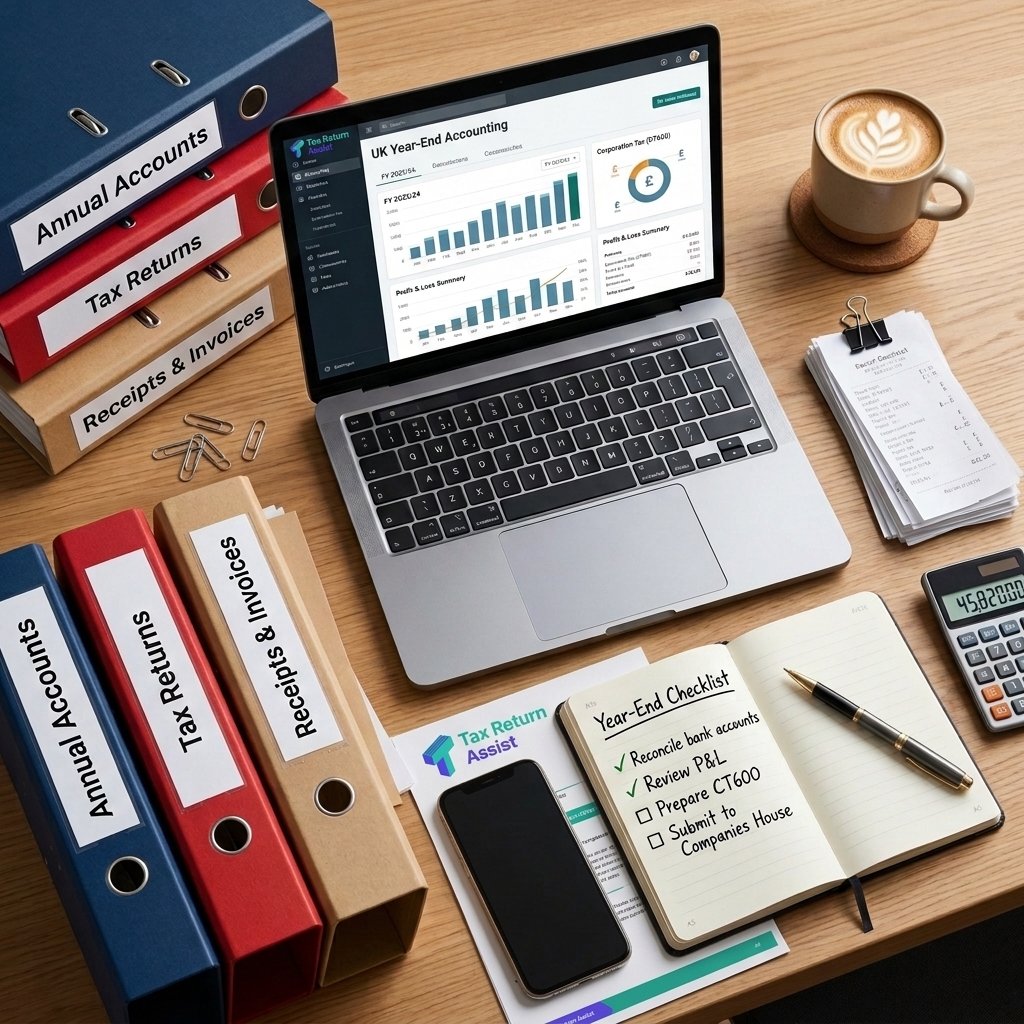
What do you need to prepare your limited company annual accounts?
October 29, 2026

October 29, 2026
You need your bank statements, sales invoices, purchase receipts, payroll records, loan and hire purchase agreements, fixed asset details and your previous year’s accounts. Get all of this to your accountant within 4 to 6 weeks of your year end and the entire process runs smoothly.
Leave it 6 months and you’re racing the Companies House deadline. Preparing annual accounts isn’t complicated if you’ve kept decent records throughout the year. The pain comes from missing documents, unreconciled bank accounts and trying to remember transactions from 10 months ago. This checklist makes sure nothing gets missed.
If you’d rather hand everything over and let someone else deal with it, Tax Return Assist’s small business accountants prepare annual accounts for limited companies across Essex and London. But whether you’re doing it yourself or briefing your accountant, you need the same documents.
Reconcile your bank accounts: Make sure every transaction in your bank account matches your bookkeeping records. If you’ve been reconciling monthly, this takes minutes. If you haven’t reconciled all year, start now. Unreconciled accounts are the number one cause of delays at year end.
Chase outstanding invoices: Any money owed to you at the year end appears as a debtor on your balance sheet. Chase it before the year closes so you know the exact figure. Also review whether any debts are genuinely unrecoverable and should be written off as bad debts.
Review your expense claims: Make sure every business expense has a receipt or record. If you’ve been putting personal expenses through the company by mistake, correct them now. Your accountant will spot them anyway, but it’s quicker and cheaper if you clean them up first.
Check your director’s loan account: If you owe the company money (or it owes you), the balance needs to be accurate at year end. Overdrawn director’s loan accounts (where you owe the company) can trigger a section 455 tax charge at 33.75%. Repaying the loan before the year end avoids this.
Review stock and work in progress: If you hold physical stock or have partially completed projects at year end, you need to value them. Stock is typically valued at the lower of cost and net realizable value. Work in progress should reflect the costs incurred on unfinished contracts.
Consider year-end tax planning: Before the year closes, check whether there are legitimate steps to reduce your tax bill. Pension contributions, purchasing equipment (to claim capital allowances), timing of dividend payments, and deferring income where commercially sensible. Once the year end passes, the opportunities for that period are gone.
This is the core of the year-end process. Your accountant needs all of the following to prepare your accounts:
1. Bank statements. All business bank accounts, for the full 12-month accounting period. If you use online banking, download the statements as PDFs or CSVs. If your accounting software connects to your bank, make sure the feeds are up to date and fully reconciled.
2. Sales records. All sales invoices issued during the year. A list of debtors (amounts owed to you) at the year end. If you use accounting software, this is generated automatically. If not, compile a list from your records.
3. Purchase invoices and receipts. Every supplier invoice and expense receipt for the year. A list of creditors (amounts you owe to suppliers) at the year end. Categorised if possible: office costs, travel, professional fees, marketing, subscriptions.
4. Payroll records. P60s for all employees (including the director). Payroll summaries showing gross pay, PAYE, NIC, pension contributions and net pay for each month. If your accountant runs your payroll, they already have these.
5. PAYE and NIC payments. Records of all payments made to HMRC for PAYE and National Insurance during the year. These should match the payroll records.
6. VAT returns (if VAT-registered). Copies of all VAT returns filed during the year. The VAT account showing payments made and refunds received. If your accountant handles VAT, they’ll have these on file.
7. Loan and hire purchase agreements. Details of any business loans, overdrafts, credit cards or hire purchase agreements. Outstanding balances at the year end. Interest paid during the year.
8. Fixed asset records. A list of assets purchased during the year (equipment, vehicles, computers, furniture) with costs and dates. A list of any assets sold or scrapped during the year. Your accountant needs these to calculate capital allowances.
9. Director’s loan account. A running record of all money the director put into the company, took out of the company, dividends declared and any personal expenses paid by the company. The closing balance is critical for the accounts and for any section 455 tax implications.
10. Dividend records. Board minutes (or written resolutions) for every dividend declared during the year. Dividend vouchers showing the date, amount per share and total amount. These are legal requirements, not optional admin.
11. Previous year’s accounts. Your accountant needs these as the starting point. Opening balances carry forward from the previous year’s closing figures. If you’re changing accountants, get a copy from your previous firm.
12. Corporation tax payment records. Evidence of any corporation tax payments made during the year (for the previous year’s liability). Bank statements usually show these, but a separate note is helpful.
Once your accountant has the documents, here’s what they do:
Prepare draft accounts. They compile the financial statements: balance sheet, profit and loss account and notes. They make the tax adjustments (capital allowances, disallowable expenses, loss relief) and calculate the corporation tax due.
Review with you. A good accountant walks you through the draft accounts before filing. They explain the profit figure, the tax bill, the balance sheet position and any issues that need attention (like an overdrawn director’s loan).
You approve the accounts. At least one director must formally approve the statutory accounts. Your name goes on the balance sheet. By signing off, you’re confirming the accounts give a true and fair view of the company’s financial position.
File with Companies House. Your accountant submits the statutory accounts electronically. Deadline: 9 months after your year end. See our Companies House filing guide for full details.
File the CT600 with HMRC. The corporation tax return, based on the same figures with additional tax adjustments. Deadline: 12 months after your year end. Our CT600 guide explains what goes on the form.
Pay corporation tax. Due 9 months and 1 day after your year end. Your accountant tells you the exact amount and the payment reference. Our corporation tax deadline guide covers the payment methods and what happens if you’re late.
Missing bank statements. If your accountant can’t see 2 months of bank transactions because you didn’t download the statements or your bank feed disconnected, they can’t start the accounts. Check before you hand everything over.
Unreconciled bookkeeping. If your Xero or FreeAgent shows a bank balance that’s £3,000 different from your actual bank balance, your accountant has to find out why before they can do anything else. That investigation eats time.
Missing dividend paperwork. If you took dividends during the year but didn’t create board minutes or dividend vouchers, your accountant needs to prepare them retrospectively. This is common but adds to the bill and the timeline.
Director’s loan account confusion. If you’ve been taking money out of the company without clear records of whether it’s salary, dividends or a loan, your accountant has to untangle the account before the accounts can be finalised. This is one of the most time-consuming issues at year end.
Handing records over late. If your year end is 31 March and you don’t give your accountant the records until November, they’ve got barely a month before the Companies House deadline (31 December). That’s rush territory. Hand records over within 4 to 6 weeks of your year end and everyone has breathing room.
Keep your bookkeeping up to date. If your records are reconciled monthly throughout the year, the year-end handover takes an hour instead of a day. This is the single biggest time and cost saver. If you don’t want to do bookkeeping yourself, a bookkeeping service handles it for a fixed monthly fee.
Use cloud accounting software. Xero, FreeAgent or QuickBooks. Your accountant can access your records in real time without you needing to email spreadsheets or post documents. Bank feeds are automatic. Year-end reporting takes a fraction of the time.
Keep a year-end folder. Throughout the year, save anything your accountant will need: asset purchase invoices, loan agreements, dividend board minutes, HMRC correspondence. When year end arrives, the folder is ready to hand over.
Communicate with your accountant early. Tell them about any unusual transactions during the year: large asset purchases, director’s loans, changes in shareholding, new contracts. No surprises at year end means no delays.
Tax Return Assist prepares annual accounts for limited companies across Essex and London. Their accountants handle the full year-end process: statutory accounts, CT600, Companies House filing, corporation tax payment reminders and the director’s personal self assessment. Everything filed on time, with every legitimate allowance claimed.
Call 02039377911, email contact@taxreturnassist.co.uk or use the online quote form.
Disclaimer: This article is for general information purposes only and does not constitute professional financial, tax or legal advice. Tax rules and rates can change, and individual circumstances can affect the amount of tax payable. Always check the latest HMRC guidance or speak to a qualified accountant or tax adviser before making tax decisions. Tax Return Assist accepts no liability for actions taken based on the information contained in this article.

Expert tax & accountancy services for individuals, businesses, and contractors across the UK — fixed monthly or one-time fees. Trusted for our all-inclusive service plans.
Tax Return Assist Ltd is a registered Companies House Authorised ACSP, professionally regulated under the Institute of Financial Accountants (IFA).
Leave a comment