


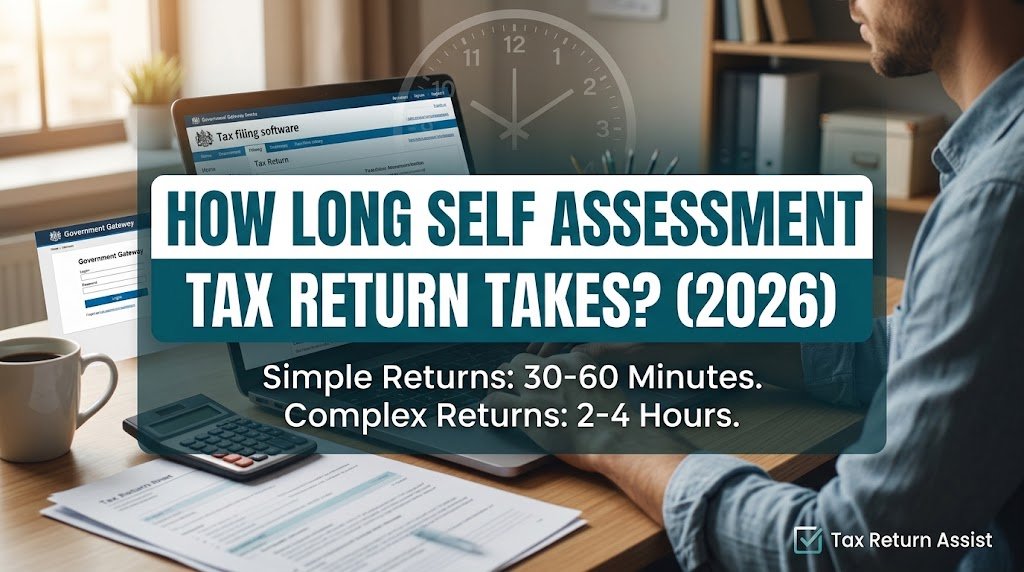
How Long Does a Self Assessment Tax Return Take? (2026)
August 22, 2026

August 22, 2026
A straightforward self assessment tax return takes 30 to 60 minutes if your records are organized. Returns with multiple income sources, rental property, or foreign income take 2 to 4 hours. But the honest answer is that how long it takes depends almost entirely on how prepared you are before you sit down to file.
The HMRC form itself isn’t complicated. It’s a guided questionnaire. Time goes on gathering documents, checking figures, and chasing missing receipts. If you’ve done that work throughout the year, the return is the quick part.
If you’d rather not spend the time at all, Tax Return Assist’s personal tax accountants handle everything from records to submission. But if you’re doing it yourself, here’s a realistic breakdown of how long each part takes.
If you’re a sole trader or freelancer with one income source and a few expenses, you’re looking at 30 to 60 minutes total. That breaks down roughly like this:
Gathering your documents: 10 to 15 minutes: Pull together your invoices or income records, expense receipts, and your P60 (if you’re also employed). If your bookkeeping is up to date, the next step is just opening a spreadsheet or logging into your accounting software.
Logging in and tailoring questions: 5 minutes: Sign into Government Gateway, select the 2025/26 tax year, and answer the initial questions about what types of income you had. HMRC uses your answers to show only the sections that apply to you.
Entering your income and expenses: 10 to 20 minutes: Type in your total turnover and your expenses by category. If you’ve got a summary from accounting software, it’s copy-and-paste. If you’re working from bank statements, it’s slower.
Reviewing and submitting: 5 to 10 minutes: Review the tax calculation HMRC generates. Please verify that the numbers look correct. Submit. Done.
Most of HMRC’s estimated completion time (around 3 hours for their records) includes record-keeping throughout the year, not just the act of filling in the form.
If you’ve got multiple income sources, the time climbs. Here’s what adds to it:
Rental income (property pages): add 20 to 40 minutes. You need income figures for each property and allowable expenses (mortgage interest, repairs, insurance, letting agent fees, and ground rent), and you need to understand the rules for finance cost restrictions if you have a mortgage. Landlords with multiple properties will spend longer. The property tax accountant page explains what’s claimable.
Capital gains: add 20 to 30 minutes. You need acquisition dates, purchase prices, sale prices, and any allowable costs for every asset you disposed of during the year. Shares, cryptocurrency, second properties. Each disposal is a separate calculation. If you’ve sold a property, you may have already reported and paid CGT through HMRC’s 60-day reporting service, but you still need to include it on the return.
Foreign income: add 30 to 60 minutes for currency conversions, working out which double taxation agreements apply, and deciding whether to claim the remittance basis. This is one area where professional help saves far more time than it costs.
Dividends and savings interest: add 5 to 10 minutes. If your only investment income is a few dividend payments and bank interest, this section is quick. Gather the figures from your investment platform statements and bank annual summaries.
Employment alongside self-employment: add 10 to 15 minutes. Your P60 figures go in the employment section. If you’ve had multiple employers or received benefits in kind (company car, private medical insurance), it takes a bit longer.
A landlord with 3 properties, a part-time freelance business, and some share disposals could realistically spend 3 to 4 hours on their return, even with good records.
It’s never the HMRC form. It’s always the preparation.
Chasing missing records. You can’t locate the receipt for that £400 software subscription. Your bank doesn’t show old statements without a request. Your letting agent hasn’t sent the year-end summary. Each missing piece means stopping the return to hunt for it. If you’re doing this process for 10 different expenses, that’s an hour gone before you’ve typed a single number into HMRC’s system.
Reconstructing income from bank statements. If you haven’t tracked invoices throughout the year, you’re scrolling through 12 months of bank transactions trying to identify which deposits were business income and which were personal. For people who mix business and personal accounts, this alone can take hours.
Working out which expenses you can claim. First-time filers spend a lot of time Googling “Can I claim X on self-assessment?” You can avoid this entirely by reading our guide to common self assessment mistakes before you start or by getting an accountant to advise you upfront.
You may need to fix errors and re-check figures. HMRC’s system does the tax calculation automatically, but if the number looks wrong, you go back and re-check every entry. That review loop can take 20 to 30 minutes if the numbers don’t match.
Keep records throughout the year. This is the single biggest time saver. Photograph receipts when you receive them. Log mileage as you drive. Reconcile your accounts monthly, not annually. If you do 10 minutes of admin per week, the return itself takes 30 minutes. If you do 0 minutes per week, the return takes 4 hours.
Use accounting software. Xero, FreeAgent, QuickBooks. They categorize transactions automatically, generate tax summaries at year-end, and some even file directly to HMRC. The annual cost (£100 to £200) is less than one hour of your time if you bill £200 or more per hour.
Separate your business and personal banking. One bank account for business and one for personal. When every transaction in your business account is a business transaction, reconciliation takes only minutes instead of hours.
Prepare your documents before you begin. P60, bank interest statements, dividend vouchers, property income summaries, expense records. Pile them up. Then sit down and work through the return in one go. The list of what you need to file is in our step-by-step guide.
File early in the tax year. Filing in May or June means HMRC’s servers aren’t being hammered, there are no timeout errors, and you’re not competing with 2 million other people filing in the last 48 hours of January. The system runs faster because there’s less load.
Yes. Expect your first self assessment to take roughly twice as long as it will in future years.
First-timers spend extra time on working out which sections apply to them (HMRC’s tailoring questions help, but you still need to think about it); understanding terminology (“cash basis” vs. “accruals,” “allowable expenses,” “trading allowance”); registering for Government Gateway and linking their UTR (if they haven’t done this already); and simply navigating an unfamiliar online system.
If you haven’t registered yet, the registration guide walks through that process separately. Complete your registration first so you can focus solely on the return when you sit down to file.
By year 2 or 3, you know the form, you know what’s claimable, your records system is established, and the whole thing takes half the time.
From your side? About 30 minutes to gather your documents and send them over. Your accountant handles everything else.
From their side, a typical sole trader return takes an experienced accountant 1 to 2 hours. Complex returns with property, capital gains, and foreign income might take 3 to 4 hours. But that’s their time, not yours.
The real value isn’t just the time saved. They spot expenses you’d miss, avoid mistakes that would cost you more than their fee, and give you peace of mind that everything’s filed correctly and on time.
Tax Return Assist’s self-employed accountants and small business accountants handle the full process. You send your records, they file the return, and you get a confirmation when it’s done.
Whether your return takes 30 minutes or 4 hours, that’s time you could spend on your business, your clients, or your life. An accountant turns it into a 30-minute handover and takes everything else off your plate.
Call Tax Return Assist on 02039377911, email contact@taxreturnassist.co.uk, or get an instant quote. They file returns for sole traders, landlords and businesses across Essex and London, usually within a few days of receiving your records.
Disclaimer
Disclaimer: This article is for general information purposes only and does not constitute professional financial, tax, or legal advice. Tax rules change frequently, and individual circumstances vary. Always consult a qualified accountant or tax adviser before making decisions based on this content. Tax Return Assist accepts no liability for actions taken based on the information provided here.

Expert tax & accountancy services for individuals, businesses, and contractors across the UK — fixed monthly or one-time fees. Trusted for our all-inclusive service plans.
Tax Return Assist Ltd is a registered Companies House Authorised ACSP, professionally regulated under the Institute of Financial Accountants (IFA).
Leave a comment